Scandinavian interior design: light, warm and made for living.
Pale wood, soft linen, a lamp glowing in the corner and nothing you don’t need. Scandinavian interiors look calm, but they are really about everyday happiness: rooms that are easy to use, kind to the eye and warm to come home to. Here is where the style comes from, the colours and materials that make it, and how to bring it into an Indian home without shivering.
What Scandinavian interior design really means
Strictly speaking, Scandinavia is Denmark, Norway and Sweden. Designers usually add Finland and Iceland too, and the word for all five is Nordic. Each country has its own accent, but they share an idea that took shape over the last century: everyday things should be useful, beautiful and within reach of ordinary families, not only the wealthy.
That idea shows up as a handful of habits. Rooms are bright and uncluttered, so daylight can travel. Furniture is simple, well made and comfortable, with honest wood and gentle curves. Materials come from nature: oak, birch, wool, linen, leather and clay. Colour is soft, with a few warm accents. And every room is lit for the evening, because Nordic winters are long and dark.
It is easy to confuse the style with minimalism, but the two feel different. Minimalism is about reduction. Scandinavian rooms keep family photographs, a stack of books, a throw on the sofa and a plant on the sill. Scandinavian design is not about owning less. It is about loving what you own, and giving each thing a good place to live.
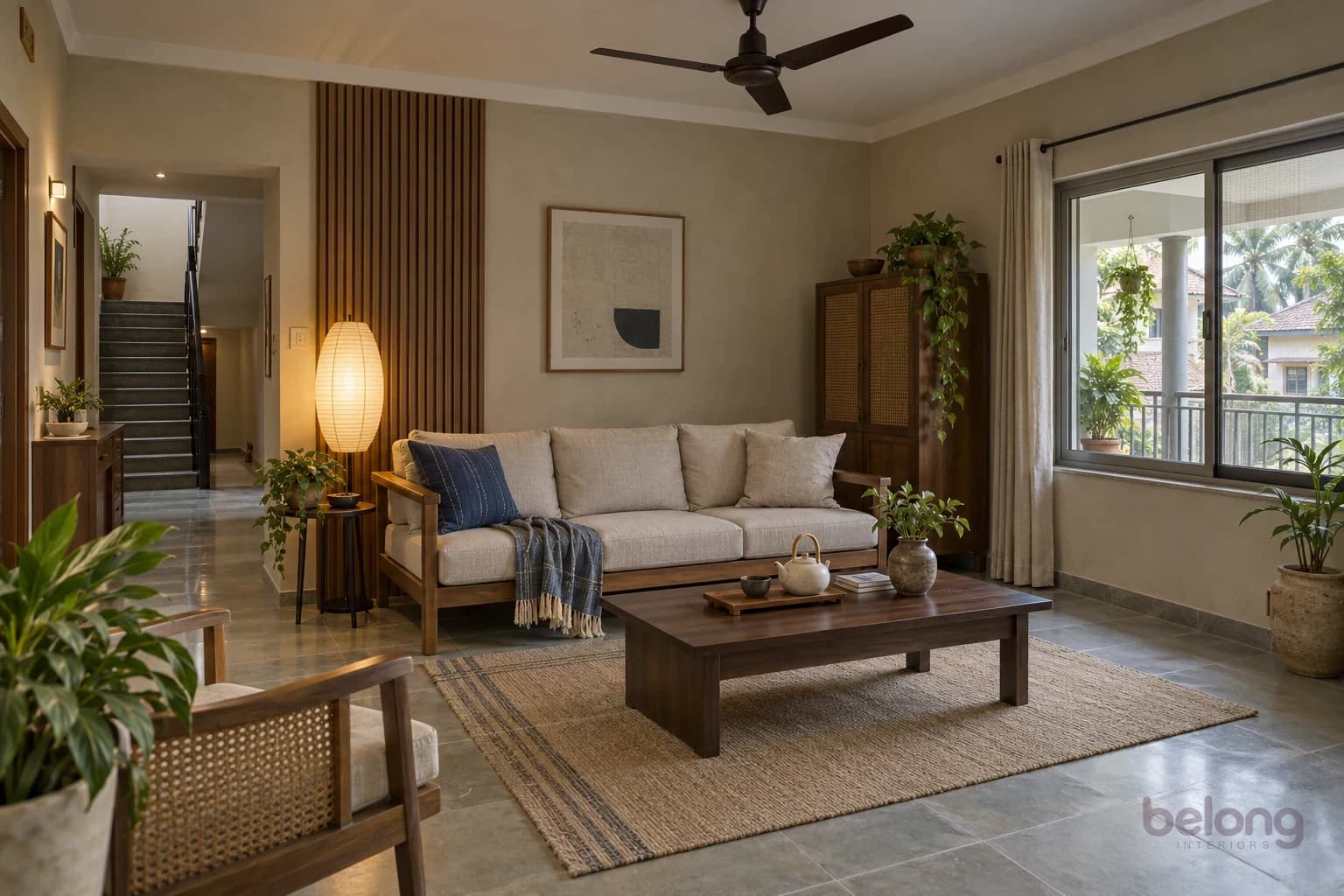
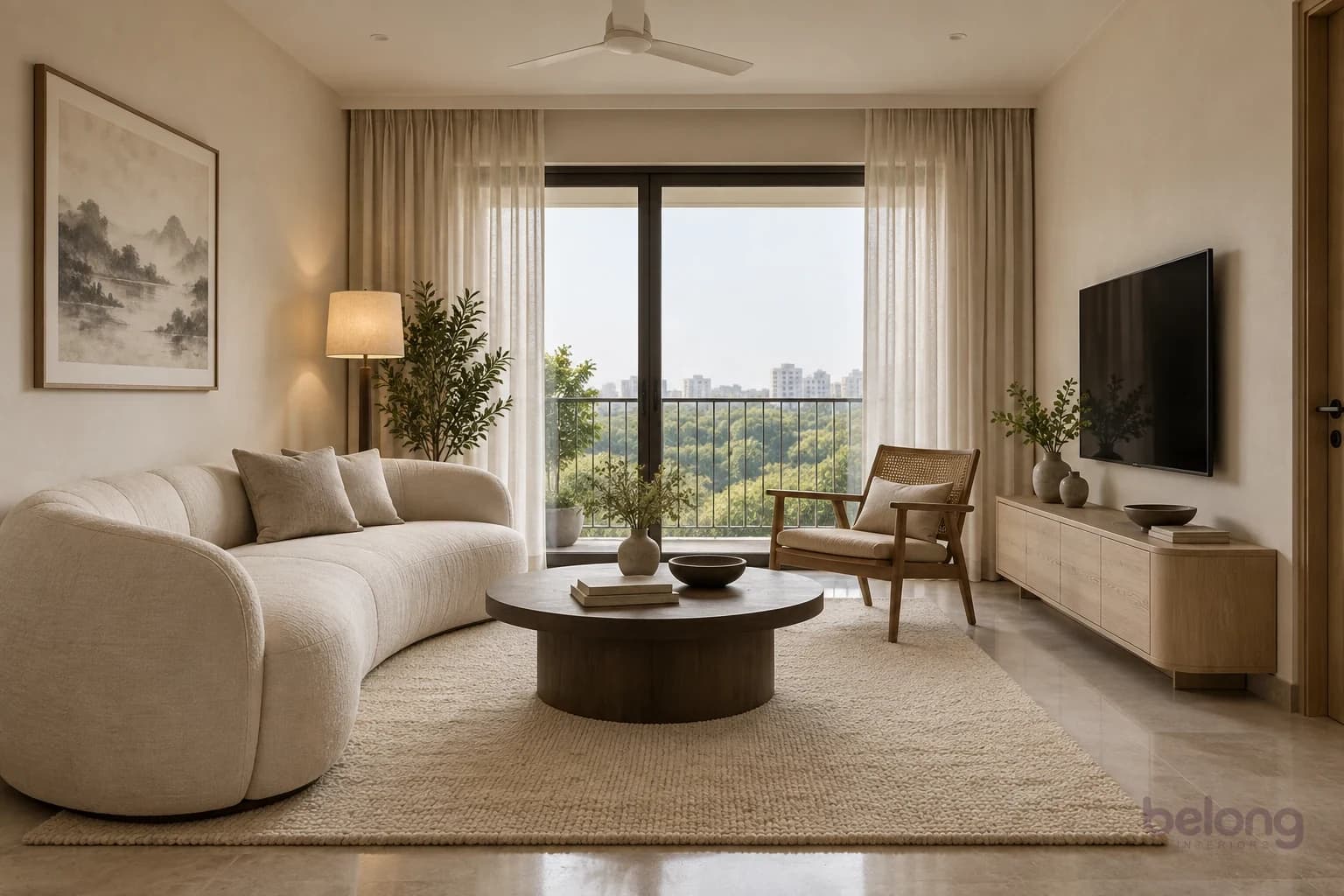
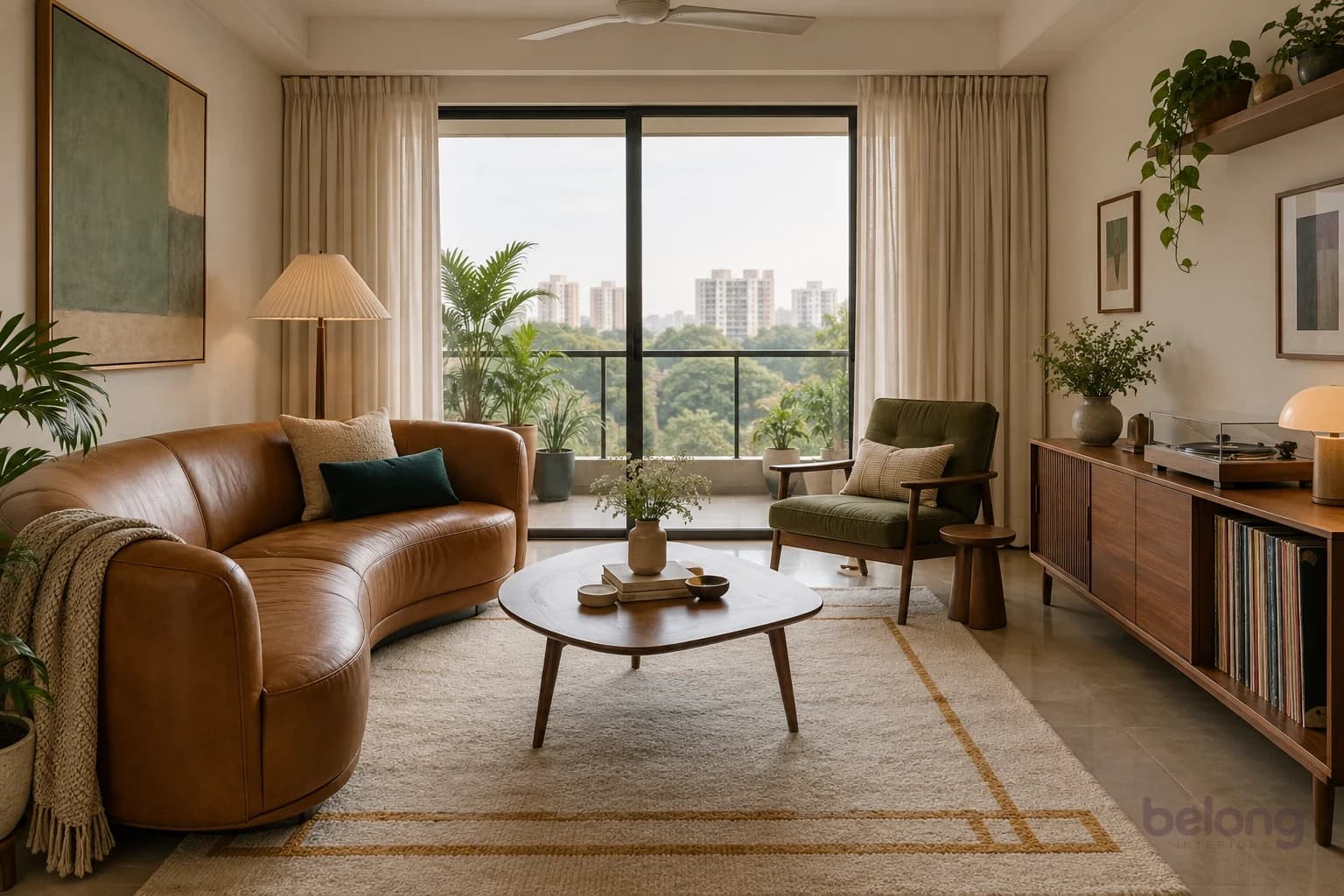
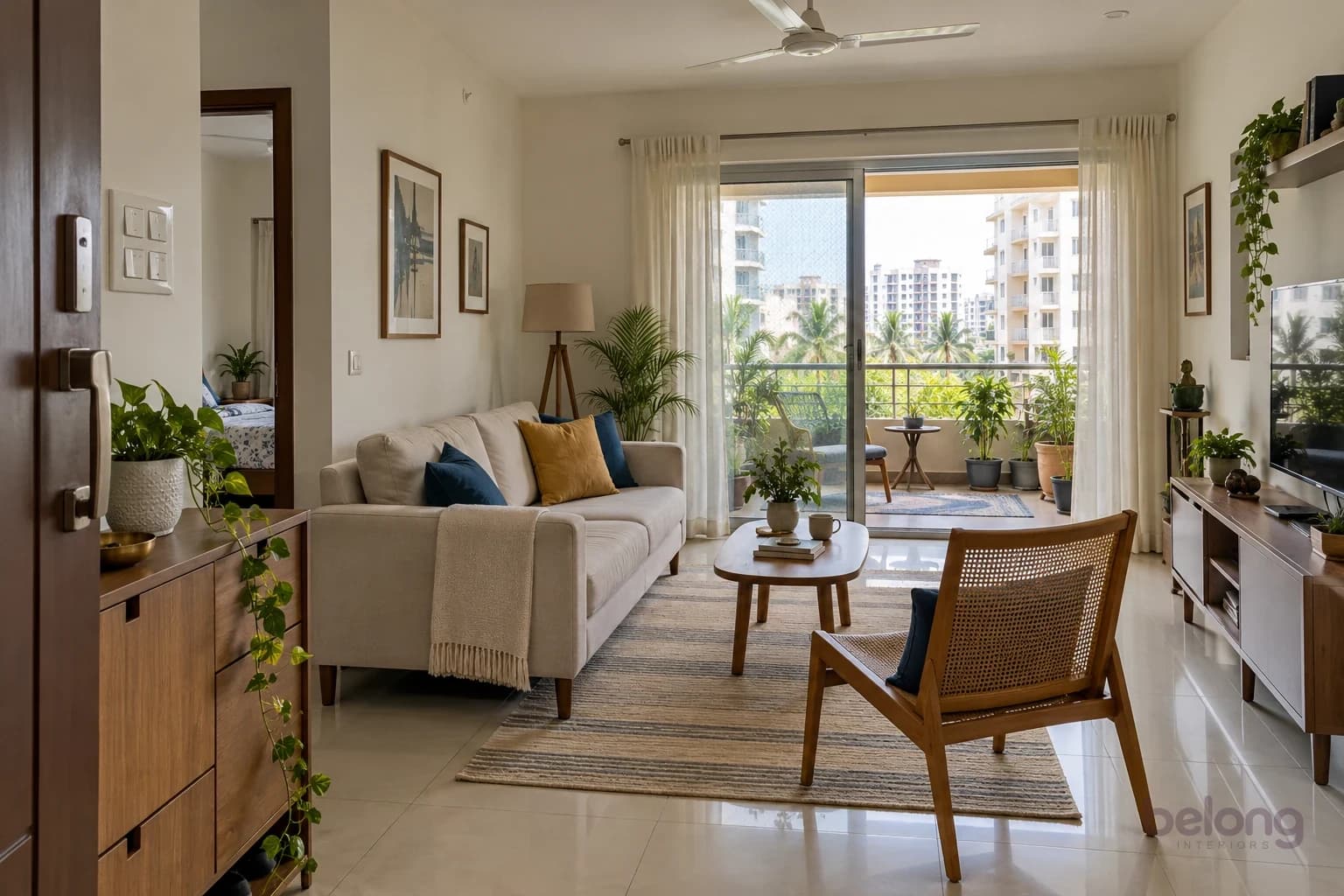
Scandinavian style in six pictures
Pale wood, soft linen, warm light and a cosy corner. Tap any photo to see it big.
Photos are AI-generated design studies, not completed Belong projects.
Hygge, lagom and the words behind the look
You can’t talk about Nordic homes for long without hearing hygge. It is a Danish word, said roughly “HOO-guh”, for the cosy, contented feeling of being warm and at ease with people you like. Think candlelight, a pot of tea, socks on, nowhere to be. In 2016 it was shortlisted for the Oxford word of the year, which tells you how far the feeling has travelled.
Sweden has lagom, “LAH-gom”, which means not too much and not too little: just right. It is a lovely test for a room. Enough seats, not a crowd of chairs. Enough lamps, not a showroom. Norway has koselig, a warm, sociable cosiness, and friluftsliv, the love of open-air life, which is one reason Nordic homes bring wood, plants and daylight indoors.
Then there is the hyggekrog, a Danish word for a cosy nook: a window seat, a deep chair in a corner with a blanket and a lamp. If you do only one Scandinavian thing at home, make a hyggekrog. It costs very little and it changes how a room feels in the evening.
Six Nordic words for a happier home
Flip each card to see what the word means, and one small way to try it this week.
Scandinavian design is not about owning less. It is about loving what you own, and giving each thing a good place to live.
A short history: from painted cottages to the chair everyone knows
The roots go back to the late 1700s, when King Gustav III of Sweden brought home a taste for French neoclassical style and Swedish makers simplified it. Instead of gilding, Gustavian furniture was painted in pale grey, cream and soft blue, partly to make the most of weak winter light. In 1899 the artist Carl Larsson published Ett hem, “A Home”, watercolours of the house he and his wife Karin, who designed many of its textiles and interiors, had made in the village of Sundborn. Its light painted wood and family rooms became the picture of a happy Swedish home.
The same year, the writer Ellen Key argued in Beauty for All that a lovely home should not depend on money. In 1919 Gregor Paulsson called for “more beautiful everyday things”, and the 1930 Stockholm Exhibition showed light, practical modern homes to the public. In Denmark, Kaare Klint began teaching furniture design in 1924 by measuring real bodies and real belongings. In Finland, Alvar and Aino Aalto bent birch plywood into warm, affordable furniture and founded Artek in 1935.
After the war came the golden age of Danish Modern: Hans Wegner’s Round Chair and Wishbone Chair in 1949, Poul Henningsen’s glare-free lamps, Arne Jacobsen’s chairs of the 1950s. A touring exhibition, Design in Scandinavia, carried the look across North America from 1954 to 1957, and the name stuck. Marimekko added joyful pattern from 1951, and flat-pack furniture made the style affordable to millions.
From painted cottages to the chair everyone knows
Tap a year, or step along with the arrows. Each moment still shapes Scandinavian homes today.
Gustavian style
King Gustav III brings French neoclassical taste home, and Swedish makers simplify it, painting furniture in pale grey, cream and soft blue instead of gilding it.
at home today Painted furniture and pale walls that make the most of winter light.
1780s: Gustavian style
Light is the whole point
On the shortest day of the year, Stockholm gets about six hours of daylight and Helsinki a little less. That single fact explains a great deal. Walls, ceilings and floors are kept pale to bounce every bit of light deeper into the room. Windows are dressed lightly. And when the sun sets in the middle of the afternoon, the lamps come on.
Nordic homes are lit in pools, not floods. Instead of one bright ceiling light, a room might have a pendant hung low over the dining table, a floor lamp by the sofa, a table lamp on the sideboard and a small lamp in the window. Each makes a warm circle at a different height, and together they make the room feel soft and inviting. Denmark also burns more candles per person than any other country in Europe.
Bulbs matter as much as fittings. Warm white bulbs, around 2,700 kelvin, give the golden glow you see in Scandinavian photographs, and dimmers let a room shift from working to winding down. Poul Henningsen designed his layered lamp shades in the 1920s so that you never see the bare bulb, only gentle reflected light. It is still the best lighting advice there is.
Dial up the hygge
It’s a December afternoon and the sun is setting early. Move the clock, switch lamps on and off and change the bulbs, and watch the mood follow.
Bright, but flat. Like a waiting room. Cosiness 1 out of 5.
Light layers
Bulbs
An illustration of the idea. Real rooms also depend on your walls, shades and windows.
The Scandinavian colour palette
The base is white, but rarely a cold one. Chalky, slightly warm whites, oat and linen tones, pale greige and soft Gustavian greys do most of the work on walls and big pieces. They reflect light without glaring, and they let wood and textiles take the lead.
Then come the quiet colours: dusty fjord blue, eucalyptus sage, blush clay and pine green, used on a bedroom wall, a cabinet or a sofa. A Scandinavian room usually has one darker anchor too, a soft charcoal lamp base, picture frame or chair, so the pale colours have something to rest against. Accents are warm and small: ochre cushions, a mustard throw, a little red.
That red is Falu red, the earthy colour of Sweden’s countryside cottages. It was made from the residue of the copper mine at Falun, now a UNESCO World Heritage Site, and it let timber houses imitate the brick homes of the rich. A Falu red door, stool or blanket is a lovely nod to the style. Try any of the palettes on the room above, and remember to test real paint in your own light.
The Scandinavian colour palette
Five ready palettes in 60-30-10 order, and fourteen colours to play with. Tap a chip to try it on the walls, or copy its code.
Pale and quiet, with charcoal to hold it together.
- 60% · WallsChalk white
- 30% · Sofa & rugGustavian grey
- 10% · AccentsSoft charcoal
Every colour, one tap away. Tap a chip to try it on the walls.
Codes are close screen matches, not brand paints. Always test a real sample on your own wall.
Materials and textures that make it warm
Wood is the heart of a Scandinavian room. Oak is the Danish favourite, birch is the Finnish one, and pine, ash and beech appear everywhere. Floors are often wide planks with a soap, white-oil or matte finish that keeps the wood pale and natural rather than shiny. Teak had its moment in the 1950s and 60s, and a few warm mid-tone pieces still sit happily beside pale ones.
Textiles soften all that timber. Wool throws, flatweave and knotted rya rugs, linen curtains and cushions, leather on a chair arm and a sheepskin on a seat give a room its touchable layer. Paper cord, cane and rattan are part of the tradition too: Wegner’s Wishbone Chair has a seat woven by hand from about 120 metres of paper cord.
Finish with things made by hand. Stoneware mugs, a glass vase, a ceramic lamp base and a woven basket bring small imperfections that keep a pale room from feeling sterile. The trick is to mix two or three wood tones and several textures, rather than matching everything. Tap the dots on the photo to see how each material plays its part.
Spot the Scandinavian details
Every material in this room has a job. Tap a number to see what it does.
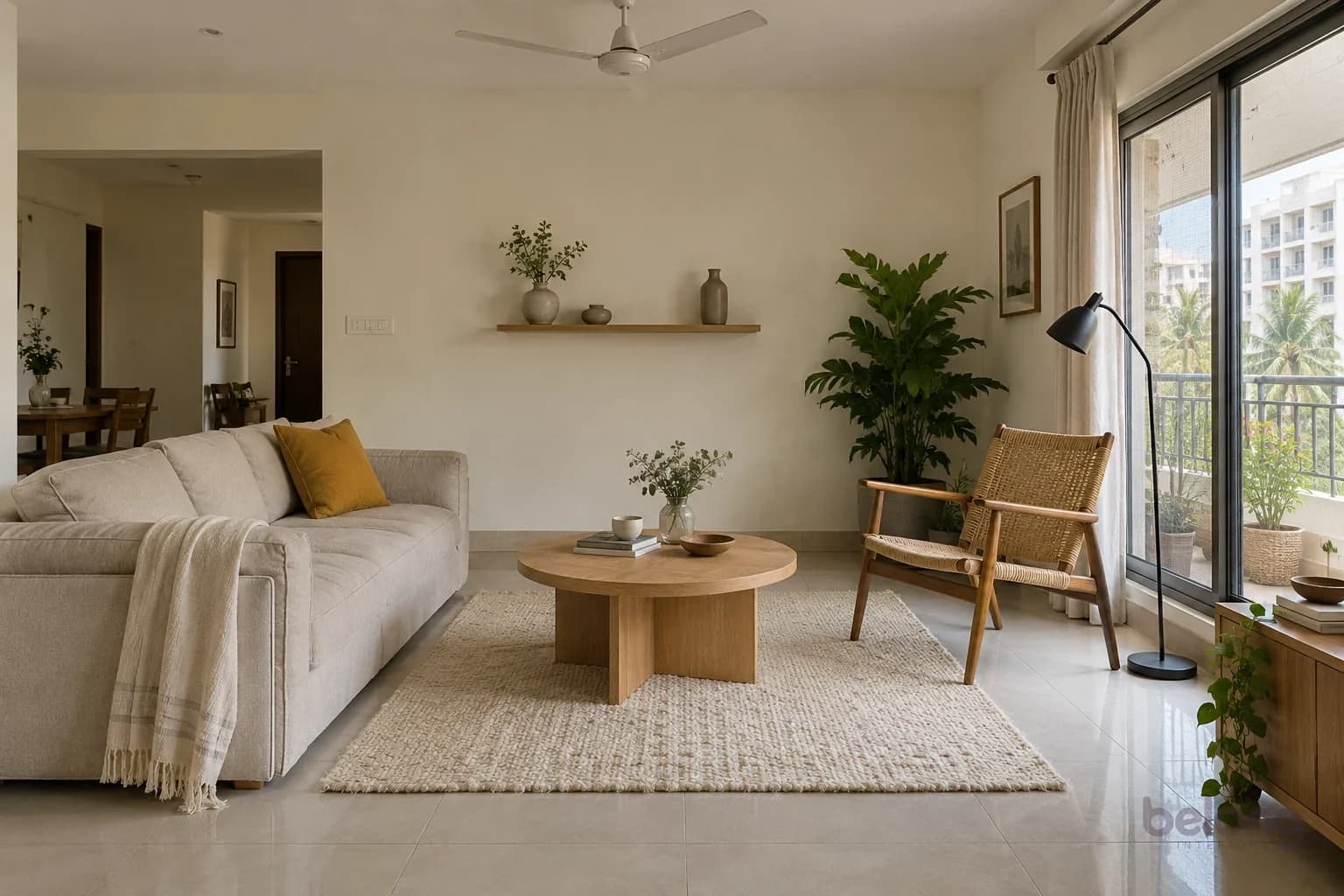
1Linen sofa. Linen is cool to the touch, softens with every wash and keeps its relaxed creases. Cotton-linen blends are easier to care for.
Photos are AI-generated design studies, not completed Belong projects.
The pieces that say Scandi
Some pieces do a lot of the work. A wooden dining chair with a spindle or curved back and a woven seat. A low, deep sofa in oat linen with a throw over one arm. A daybed or bench that doubles as extra seating. A round or oval dining table, which makes conversation easy and fits small rooms well.
On the walls, look for light shelving that floats: wall-hung shelves, slim ladders and peg rails with hooks for bags, coats and baskets. The String shelf, designed in Sweden in 1949 for small homes, is still a template. Picture ledges let you change art without new holes, and a few framed prints in simple wood or black frames feel personal without clutter.
Lighting pieces are often the stars: a sculptural pendant over the table, a paper or linen shade, a slim floor lamp. Add a flatweave rug big enough for the front legs of every chair to rest on it, and plants in simple pots. Swipe through the prints below for a few favourites.
Six pieces that say Scandi
Drag or swipe along the row, and tap a print to see it big.
The spindle-back chair
Wood, a gentle curve and a woven seat. Mix two styles around one table.
The daybed
Seat by day, guest bed by night, and the best spot for an afternoon nap.
The floating shelf
Wall-hung shelves keep the floor clear and make small rooms feel bigger.
The glowing pendant
Hang it low over the table, on a dimmer, with a warm bulb.
Cotton flatweave and texture
Texture underfoot and on the bench. Choose cotton in warmer rooms.
The peg rail
Bags, baskets and coats get a home, and the room stays calm.
Photos are AI-generated design studies, not completed Belong projects. Shapes are inspired by the style, not copies of any one design.
Did you know?
A few small stories behind the pieces and colours. Tap for the next one.
did you know?
In 1950 an American magazine called Wegner’s Round Chair “the most beautiful chair in the world”. Ten years later it sat on stage at the first televised US presidential debate.
Source: Interiors magazine; Phillips
Room by room: Scandinavian ideas you can use
Living room. Choose one comfortable sofa and one wooden chair rather than a matching set. Light it at three heights, with a floor lamp, a table lamp and something low in the window. Use a rug large enough to hold the furniture together. In the bedroom, keep the walls pale and add one soft colour behind the bed, choose linen or cotton bedding, and fix reading lights to the wall so the bedside tables stay clear.
Kitchen and dining. Flat-front cabinets in pale oak, sage or soft grey with simple wooden or leather pulls are classic. Keep one open shelf for everyday crockery and put the rest behind doors. Over the table, hang a warm pendant on a dimmer. A bench on one side of the table seats more people in less space.
The small rooms count too. In a bathroom, pale tiles with a teak stool and waffle cotton towels on hooks feel calm. In a child’s room, low open shelves, birch-ply furniture and a peg rail make tidying easy. A work nook needs a wall-hung desk, a pinboard and a warm task lamp. And by the front door, a bench, a row of hooks and a closed shoe cupboard bring that Nordic calm to the very first step inside.
A Scandinavian home, room by room
Pick a room, or swipe the photo, for the ideas that make it work.
01 / 08
Living
Comfortable, lit in pools and arranged for conversation.
- One good sofa and one wooden chair beat a matching set.
- Light it at three heights: floor, table and window.
- Use a rug big enough to hold the whole seating group.
Palette
Living: Comfortable, lit in pools and arranged for conversation.
Photos are AI-generated design studies, not completed Belong projects.
Scandinavian style in a warm, sunny Indian home
Most of the style travels beautifully: decluttered rooms, closed storage, a shoes-off entrance, plants, simple wooden furniture and warm, layered lamps. The difference is light. In many Indian homes, strong daylight makes glare and heat a bigger design concern than darkness. Choose warm whites and oat tones over brilliant cool white on sunlit walls, and dress windows with sheer cotton or linen plus a blind, so daylight is soft rather than harsh.
Swap the cold-climate textiles for breathable ones. Cotton and linen throws, handloom cushions and flatwoven cotton or jute rugs give the same layered feel without trapping heat, and keep wool and sheepskin for air-conditioned bedrooms. Candles soften in the heat and don’t mix with fans or curtains, so let warm 2,700 K lamps and a rechargeable table light do their job. A ceiling fan in white or pale wood can sit happily in a Scandinavian room. Keep pendants out of its sweep.
Take care with timber. Birch and ash look wonderful but resist insects poorly, while teak heartwood is famously durable. For the pale look, use oak or ash veneer on termite-treated, water-resistant plywood, with marine-grade board near water. Choose wipeable matte paint and washable slipcovers for the monsoon months. Our guide to designing for rainy months goes deeper.
Same room, made Scandinavian
An ordinary living room, before and after: warm whites, light oak, cotton and linen, blinds for the glare and lamps in layers.
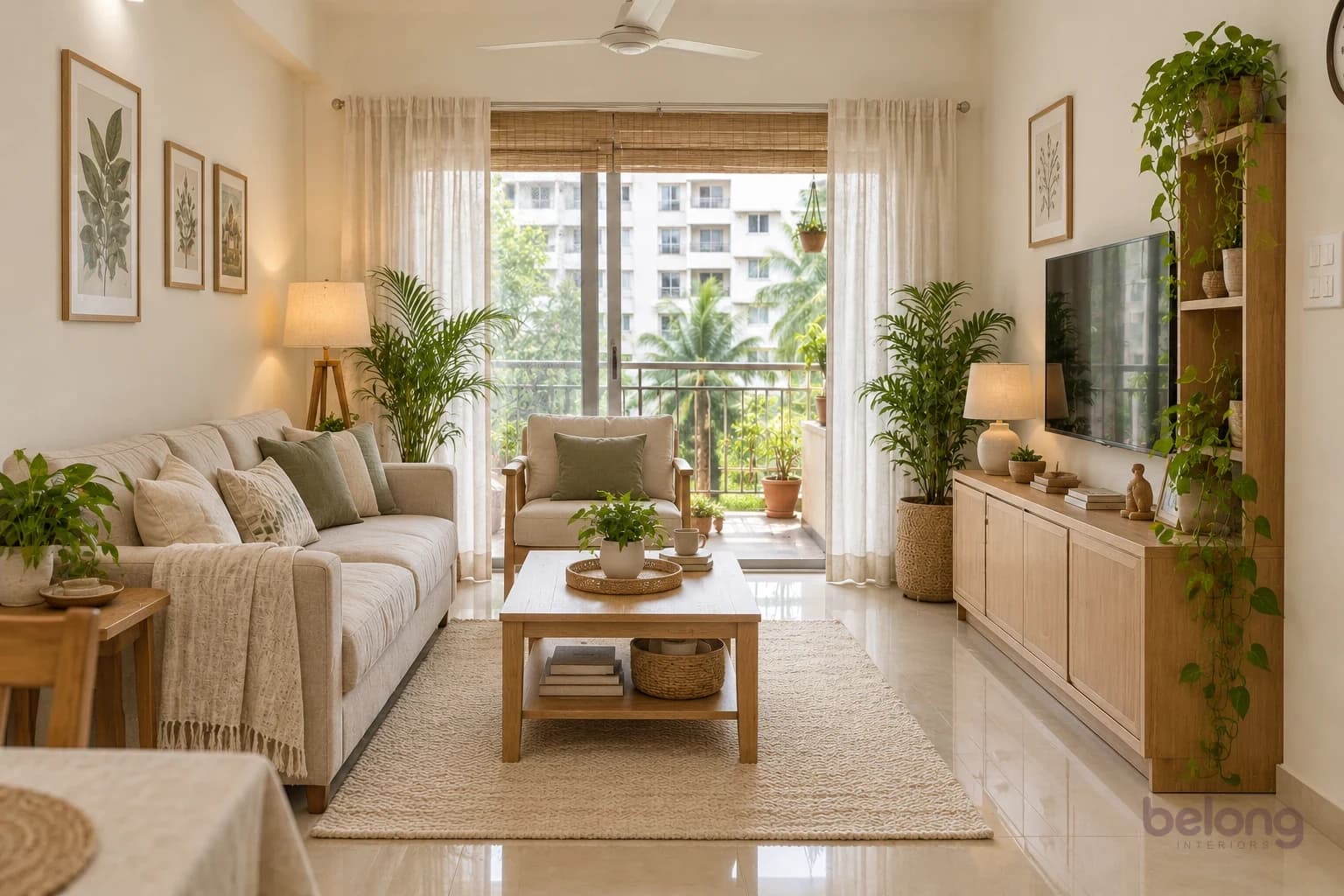
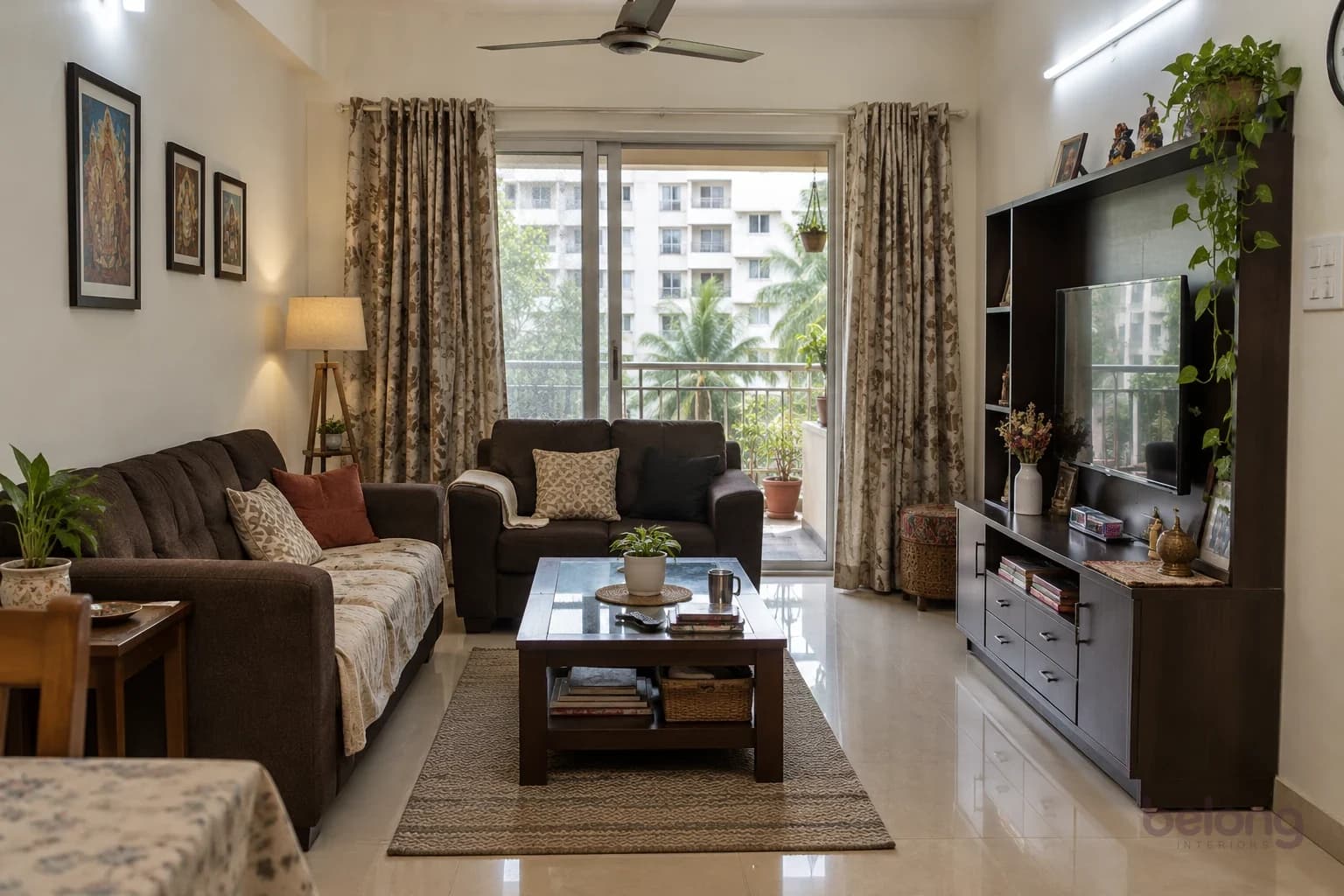
Photos are AI-generated design studies, not completed Belong projects.
Build a hyggekrog
Add cosy things to the nook one by one, then flip the weather to see how the idea changes for a warm, humid home.
2 of 8 cosy things
Wool, sheepskin and candlelight for a cold, dark evening.
Mistakes that make it feel cold, and the easy fixes
The most common one is all-white everything: bluish white walls, white furniture and no texture, lit by one bright ceiling light. It photographs well and lives badly. Warm the whites, add wood and textiles, switch to warm bulbs and add two lamps at different heights. Another is matching every wood exactly. Mix two or three tones and one darker piece, and the room will look collected rather than bought in a day.
Watch the small things too. Rugs that are too small make furniture float, so size up. Curtains hung low and short shrink a window, so mount them high and wide. A shelf of slogan prints and trendy accessories can make a room feel like a shop. Choose fewer, better pieces that you’ll keep for years, which is the most Scandinavian idea of all.
Finally, don’t forget comfort. A room that is beautiful but has nowhere soft to sit, no reading light and no place for a cup of tea is missing the point. Tick off what your room already has in the little check below, and see how close you are.
How Scandi is your room?
Tick what your room already has. No wrong answers, just ideas for what to add next.
0/10Scandi touches
Let’s begin
Every Scandinavian room starts somewhere. Tick what your room already has.
Questions, answered
What are the key characteristics of Scandinavian interior design?
Bright, uncluttered rooms; pale walls and floors; simple, well-made furniture in natural wood; textiles such as wool, linen and cotton; soft colours with a few warm accents; plants; and warm, layered lighting. Comfort matters as much as looks.
What colours are used in Scandinavian interiors?
Warm whites, oat and linen tones, pale greige and grey make the base. Dusty blue, sage green, blush and pine green add quiet colour. A soft charcoal anchors the room, and small accents of ochre, mustard or Falu red bring warmth.
What is the difference between Scandinavian and minimalist design?
Minimalism aims to reduce a room to the essentials. Scandinavian design is also uncluttered, but it keeps comfort, texture and personal things: throws, books, plants, family photographs and plenty of lamps. It feels warmer and more lived-in.
What is the difference between Scandinavian and Japandi?
Japandi blends Scandinavian comfort with Japanese restraint. Compared with Scandinavian rooms, Japandi furniture sits lower, wood tones mix pale with dark, colours are earthier and objects are fewer and more carefully placed.
Does Scandinavian design work in a hot, humid climate?
Yes, with a few changes. Use warm whites rather than glaring cool ones, cotton and linen instead of wool and sheepskin, sheer curtains with blinds for glare, water-resistant plywood with oak or ash veneer, and warm LED lamps instead of many candles.
Is Scandinavian interior design expensive?
It doesn’t have to be. The style was built on the idea of beauty for everyone. Pale paint, a few good lamps, cotton textiles, plants and one well-made chair go a long way. Spend on the pieces you touch every day and save on the rest.
How do I stop a Scandinavian room from feeling cold?
Warm the white walls, mix two or three wood tones, layer textiles, add one darker accent, switch to warm 2,700 K bulbs and light the room with several lamps at different heights instead of one ceiling light.
Are Scandinavian and Nordic design the same thing?
Almost. Scandinavia strictly means Denmark, Norway and Sweden, while Nordic also includes Finland and Iceland. In design, people use “Scandinavian” for all five, which is why Finnish designers such as Alvar Aalto are part of the story.
Every home is different. These notes are a starting point for your own brief, with the details shaped around your space and the people who use it.
Thinking of someone who’d like this?
Send it to the people you’re planning with, or keep it on your reading list.