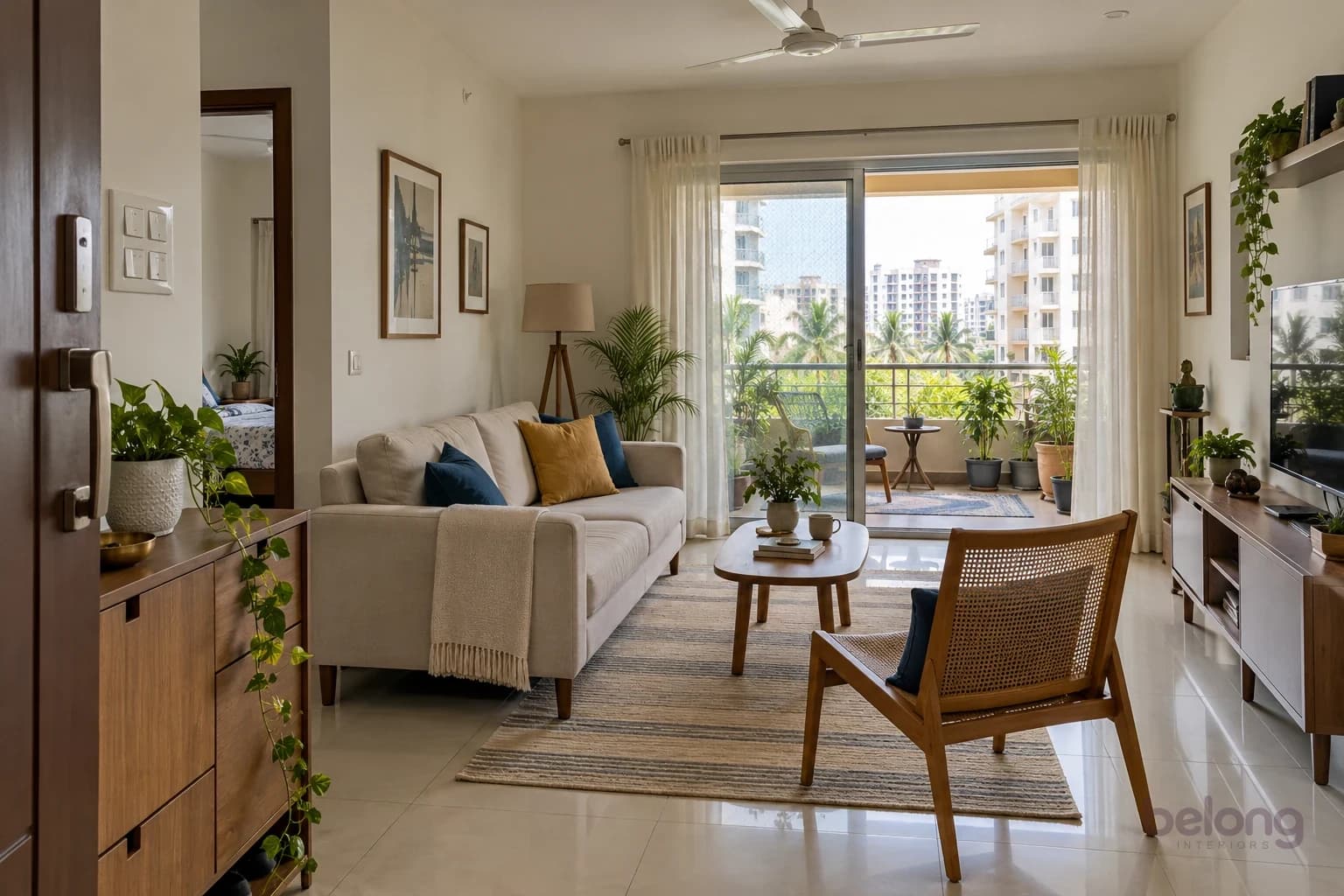
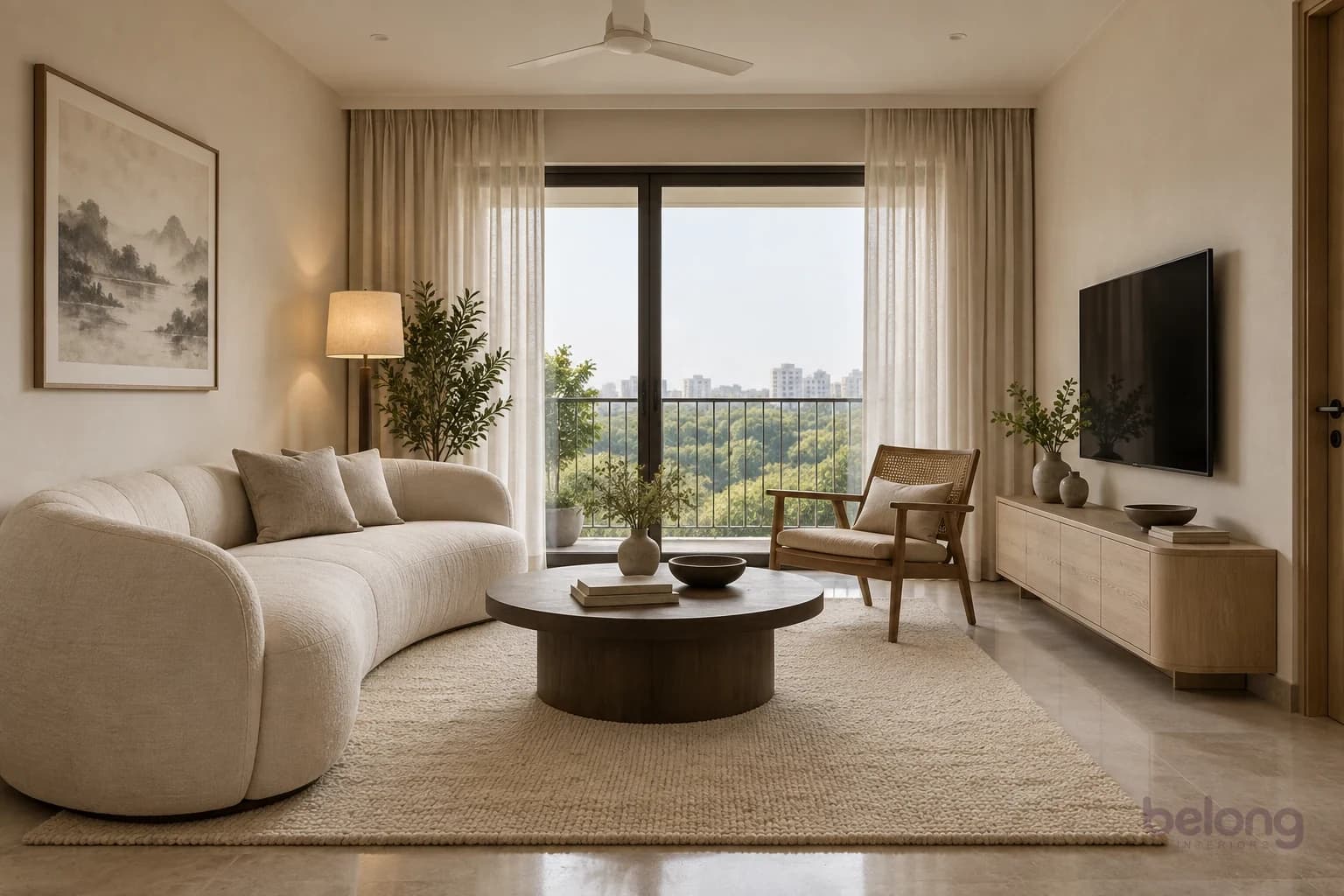
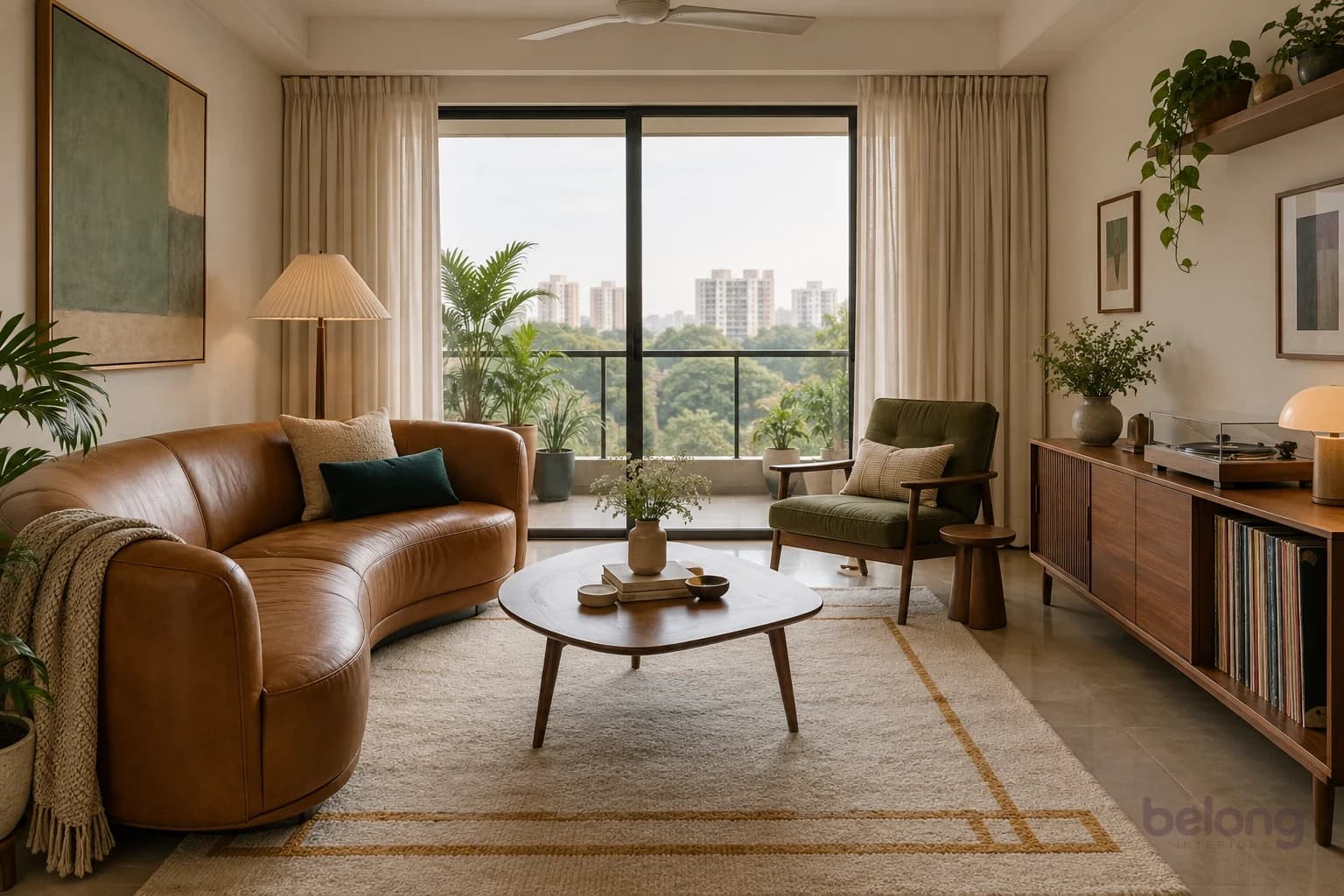
Japandi interior design: calm, warm and quietly beautiful.
Japandi is what happens when two quiet design cultures meet and get along beautifully. From Japan comes restraint, craft and a love of empty space. From Scandinavia comes comfort, warmth and practical good sense. Together they make rooms that feel calm without feeling cold. Here is where the style comes from, the ideas behind it, its colours and materials, and how to make it work in an Indian home.
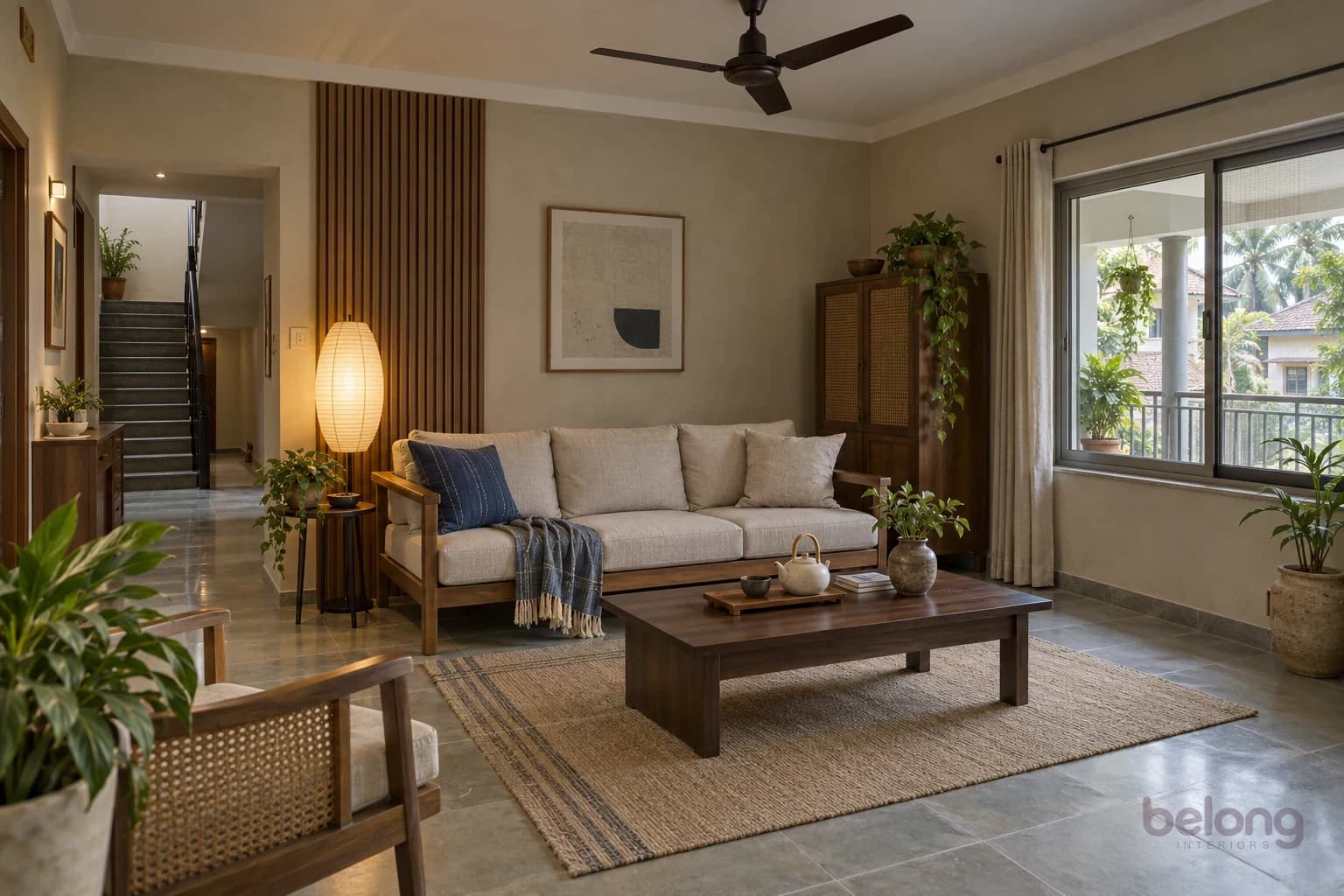
What Japandi is, and why it feels so calm
Japandi, said “juh-PAN-dee”, joins Japan and “Scandi”. Both traditions value natural materials, simplicity, honest craft and things made to last. Both dislike fuss. That shared ground is why the blend feels so natural: you are not mixing opposites, you are introducing two old friends.
Each side brings something the other lacks. A purely Japanese room can feel spare and formal to someone used to sofas and throws. A purely Scandinavian one can feel a little bright and busy with cushions and candles. Japandi takes the low, grounded furniture, earthy colours, deliberate empty space and quiet asymmetry of Japanese homes, and adds the softness, comfort and lighter woods of Nordic ones.
The result is a room that is calm but not cold, simple but not bare. You notice the grain of a table, the texture of a linen cushion, a single branch in a heavy vase, and the space around each of them. Nothing shouts. Everything is there for a reason, and most things are pleasant to touch.
Japandi in six pictures
Low oak, dark walnut, linen, one branch and plenty of space. Tap any photo to see it big.
Photos are AI-generated design studies, not completed Belong projects.
Where the name came from, and the long friendship behind it
The word is young. Design writers in Australia were using “Japandi” by the end of 2016, and in 2021 Pinterest named it one of the home trends of the year. But the friendship it describes is more than 150 years old. After Japan reopened to the world in the 1850s, Japanese prints, ceramics and lacquer swept through Europe, a craze the French called Japonisme. In 1867 Denmark and Japan signed a treaty of friendship and trade, and within twenty years Danish porcelain painters were decorating in a Japanese manner.
In the 1920s the Japanese thinker Sōetsu Yanagi and two potter friends coined the word mingei for humble, handmade everyday things, the same respect for ordinary objects that Nordic designers were arguing for at home. In 1933 the German architect Bruno Taut visited the Katsura Imperial Villa in Kyoto on his birthday and told the West that its plain, modular rooms were as modern as anything in Europe. Alvar Aalto never visited Japan, yet a German book on Japanese houses shaped his work, and Danish designers studied Japanese joinery and proportion closely.
After the war the exchange grew. Isamu Noguchi began making his paper Akari lights in 1951 with lantern makers in Gifu, and Sori Yanagi’s plywood Butterfly Stool, designed in 1954, married Western technology with Japanese form. Japandi, then, is not a fad invented for social media. It is a modern name for a long conversation between two cultures that admire each other.
How Japan and Scandinavia found each other
Tap a year, or step along with the arrows. The word is new; the friendship isn’t.
Japan opens its doors
After more than two centuries of seclusion, Japan signs its first treaty with the United States, and trade with Europe soon follows.
at home today Japanese prints, lacquer and ceramics begin to arrive in Western homes.
1854: Japan opens its doors
Empty space is not wasted space in a Japandi room. It is what lets the things you love be seen.
The Japanese ideas that shape the room
A few Japanese words often come up in Japandi, and they are worth knowing, as long as we treat them as inspiration rather than decorating rules. Wabi-sabi, “WAH-bee SAH-bee”, finds beauty in things that are simple, imperfect and touched by time: a handmade cup that isn’t quite round, wood that darkens where hands rest. Ma, “mah”, is the meaningful gap or pause between things, the space that lets each object be seen.
Kanso means simplicity, removing what isn’t needed. Shibui describes a subtle, unshowy beauty that grows on you. Shizen is naturalness, the feeling that nothing has been forced. Fukinsei is asymmetry, the off-centre balance you see in an ikebana arrangement or a garden path. Several of these come from writing about Zen art, and Western blogs have tidied them into neat lists, so take them lightly and enjoy them.
Two more ideas are useful at home. Mingei, folk craft, invites you to value baskets, pots and cloth made by hand for daily use. Mottainai, roughly “what a waste!”, encourages repairing rather than replacing, which is where the gold-mended seams of kintsugi come in. From the Nordic side, add hygge for warmth and lagom for “just enough”. Flip the cards below to meet them all.
Eight ideas behind a Japandi room
Flip each card for what it means, and one small way to try it at home.
Scandinavian or Japandi? How to tell them apart
Start with height. Scandinavian furniture sits at an ordinary height on slim legs. Japandi furniture is lower and more grounded: deep sofas close to the floor, platform beds, low tables. Japanese rooms go lower still, to the floor itself. If your eye drops when you walk in, you are probably in a Japandi room.
Then look at the wood. Scandinavian rooms favour pale birch, ash and oak throughout. Japandi mixes pale and dark: light oak beside walnut, smoked oak or charred timber. That contrast is the signature. Colour follows the same path, from bright whites and soft pastels in Scandinavian rooms to warm greige, clay, moss green and ink black in Japandi ones.
Finally, count the things. A Scandinavian room might have six objects on a shelf, cushions in three colours and candles on every sill. A Japandi room has three objects, arranged off-centre, with space between them. Both are lovely. Slide between them below to feel the difference.
From Copenhagen to Kyoto
One room, three ways. Watch the furniture drop, the wood darken and the shelf calm down as you slide.
- Furniture heightlow
- Woodpale + dark
- Moodcalm and warm
Japandi: Nordic comfort meets Japanese calm, in pale oak, dark walnut and clay.
The Japandi colour palette
Japandi colours come straight from nature and the craft workshop: unbleached cotton, rice paper, sand, tea, clay, moss, stone, charcoal and indigo. Japan has a rich vocabulary for exactly these quiet shades. Shironeri is the warm white of glossed silk. Torinoko, “eggshell”, is a soft oat. Rikyū-shiracha, a pale tea colour named after the tea master Sen no Rikyū, makes a beautifully calm wall.
Most of a Japandi room sits in these warm, low-contrast neutrals. Then come grounding colours: koke moss and rikyū-nezumi, a muted grey-green, for cabinets and cushions; koge-cha, a scorched brown, in walnut wood; sumi, ink black, in thin lines such as frames, lamp stems and handles. Small accents might be terigaki persimmon, bengara clay red or ai, the deep indigo of hand-dyed cloth.
Two of these have a lovely link to India. Bengara, the red-brown pigment on old Japanese woodwork, is named after Bengal, where it was once imported from. And the word indigo itself comes from the Greek for “Indian”. Try the palettes on the room above, and remember that screen colours are only a guide.
The Japandi colour palette
Five ready palettes in 60-30-10 order, and fourteen traditional Japanese colours. Tap a chip to try it on the walls, or copy its code.
Warm white, soft oat and fine lines of ink.
- 60% · WallsShironeri
- 30% · Sofa & rugTorinoko
- 10% · AccentsSumi
Every colour, one tap away. Tap a chip to try it on the walls.
Traditional colour names with close screen matches; sources vary a little. Always test real paint at home.
Materials: light wood, dark wood and the beauty of the handmade
Wood leads, and the magic is in the mix. Light oak or ash for the big pieces, walnut or a dark stained timber for a table or a frame, perhaps a panel of charred wood. Slatted timber on a wall or a headboard adds rhythm and hides wiring. Bamboo, rattan and cane bring lightness and a handmade feel, and they are at home in warm climates.
Textiles are natural and slightly rough: linen, cotton, wool and jute, in solid colours or very quiet weaves. Walls look lovely in limewash or clay plaster, which give a soft, cloudy texture instead of flat paint. Paper softens light in lanterns and screens. Stone, stoneware and handmade ceramics, ideally a little uneven, finish the room.
Choose materials that age well and can be repaired, because patina is part of the beauty. Oiled wood can be sanded and refreshed. Linen softens and creases. A chipped bowl can be mended with a golden seam. Tap the dots on the photo to see how each material plays its part.
Spot the Japandi details
Light wood, dark wood, linen, jute and paper. Tap a number to see what each one brings.
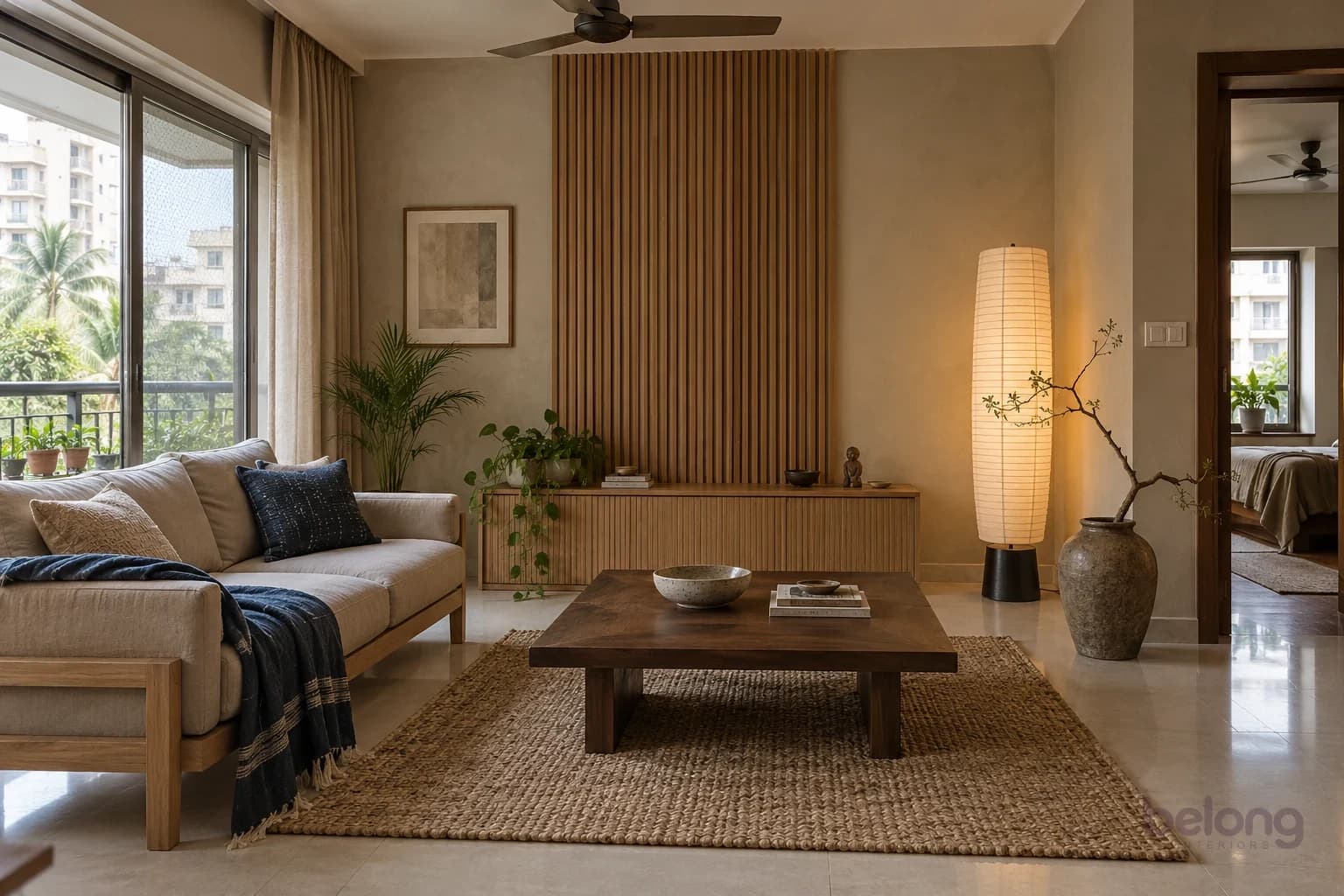
1A low oak sofa. Low and deep, so the room feels grounded. Keep the seat at a comfortable height for everyone.
Photos are AI-generated design studies, not completed Belong projects.
Furniture, lighting and the few things on show
Furniture is low, solid and simple, with softened edges: a deep, low sofa in oat linen, a platform bed, a low coffee table in dark wood, a round or slab dining table, a bench. Storage is generous and closed, ideally full height, so everyday clutter has somewhere to go. Sliding doors and slatted screens divide space without blocking light.
Lighting is soft and diffused. A paper lantern is the single most borrowed Japandi object, and for good reason: it turns a bulb into a warm moon. Add a low lamp or two and keep bulbs warm, around 2,700 to 3,000 kelvin. Avoid bright, cool downlights everywhere; they flatten the textures that make the style so lovely.
Decoration is a small, edited collection: a handmade ceramic, a stack of two or three books, a single branch rather than a bouquet, a piece of art with plenty of wall around it. Plants are welcome, especially sculptural ones. Swipe through the pieces below for ideas.
Six pieces that say Japandi
Drag or swipe along the row, and tap a print to see it big.
The paper lantern
Soft, warm and light as air. One is perfect; five is a shop.
The slatted screen
Divides space without blocking light or breeze.
The low table
Tea on the floor with cushions, a familiar comfort in many Indian homes.
Ceramics in threes
Tall, medium and low, grouped off-centre.
The simple stool
Seat, side table, plant stand. Solid wood, softened edges.
The display niche
One changing object in one special place.
Photos are AI-generated design studies, not completed Belong projects. Shapes are inspired by the style, not copies of any one design.
Did you know?
Little stories from both sides of the blend. Tap for the next one.
did you know?
Bruno Taut first saw the Katsura Imperial Villa on his birthday, 4 May 1933, the day after he arrived in Japan.
Source: Kansai University archive
Space to breathe: ma, asymmetry and the art of the few
Empty space is not wasted space in a Japandi room. It is what lets the things you love be seen. Leave one wall without art, one corner without furniture, one shelf with only two objects. Your eye rests, and the room feels larger and quieter.
Arrange objects in small, uneven groups. Three is the classic number: one tall, one medium, one low, placed off-centre on a sideboard so the group balances the empty side. This asymmetric balance feels more natural than a perfectly mirrored pair of lamps. Vary heights and textures, and keep colours close.
Borrow the idea of the tokonoma, the display alcove of a traditional Japanese room. Choose one niche, shelf or table to hold a single changing object, a seasonal branch, a ceramic or a small painting, and change it now and then. It turns styling into a gentle ritual. Try tidying the crowded sideboard below until it breathes.
Give it some ma
This sideboard is doing too much. Tuck things away until the room can breathe, then try arranging what’s left in threes.
Nothing yet. Tap anything on the sideboard or the wall to tuck it away.
Room by room: Japandi ideas you can use
Living room. A low oak sofa with linen cushions and an indigo throw, a dark wood coffee table, a paper floor lantern and one wall left deliberately empty. In the bedroom, a platform bed at a comfortable height, linen bedding in oat and charcoal, a slatted headboard and a washi pendant. Keep bedside tables simple, with a lamp, a book and nothing else.
Kitchen and dining. Flat-front cabinets in muted grey-green or light oak, an oak shelf with handmade stoneware, and appliances tucked behind doors. A fabric curtain across an open doorway, inspired by the Japanese noren, is lovely in a kitchen. At the table, a round or slab-top table, simple chairs and a low pendant, with a single branch in a vase.
In the bathroom, limewash or pale stone, a teak stool and charcoal fittings feel like a spa. A work nook can hide behind a sliding screen. At the entrance, take a cue from the Japanese genkan: a change of floor finish, a bench and a tall shoe cabinet, with slippers waiting in a basket. On the balcony, deck tiles level with the floor inside, bamboo blinds and floor cushions make a little engawa, the veranda of a Japanese house.
A Japandi home, room by room
Pick a room, or swipe the photo, for the ideas that make it work.
01 / 08
Living
Low, warm and uncluttered, with one wall left to breathe.
- A low oak sofa with linen cushions and one indigo throw.
- A dark wood coffee table for contrast.
- A paper floor lantern and warm 2,700 K bulbs.
Palette
Living: Low, warm and uncluttered, with one wall left to breathe.
Photos are AI-generated design studies, not completed Belong projects.
Japandi for Indian homes
Japandi feels surprisingly familiar in India. Many of us already take shoes off at the door, sit on the floor for meals or festivals, love cane and rattan, and value handloom cotton, khadi, terracotta and indigo. A genkan-style entrance, a low seating corner with floor cushions and a few handmade pieces will feel at home straight away.
Some things need adapting. Very low beds and floor-level sofas look beautiful but are hard on knees, especially for grandparents, so keep beds and main seats at a comfortable height and borrow the look through low proportions and solid bases. Paper screens dislike humidity; choose laminated paper, fabric or polycarbonate panels, and keep real paper away from bathrooms and kitchens. For prayer corners, build around your family’s own practice with a niche, a timber shelf and clear space, rather than using another faith’s icons as decoration.
Choose timber with care. Teak resists termites and damp far better than most woods, while pale woods such as rubberwood and ash need proper treatment. For the light-oak look, use treated oak or ash veneer on water-resistant plywood, or bamboo board. Ventilate wardrobes, choose washable slipcovers in linen and cotton, and use bamboo blinds and sheer cotton against strong sun, which yellows pale wood over time.
Same bedroom, made Japandi
A busy bedroom, before and after: a bed at a kind height, linen, slats, a paper pendant and clear surfaces.
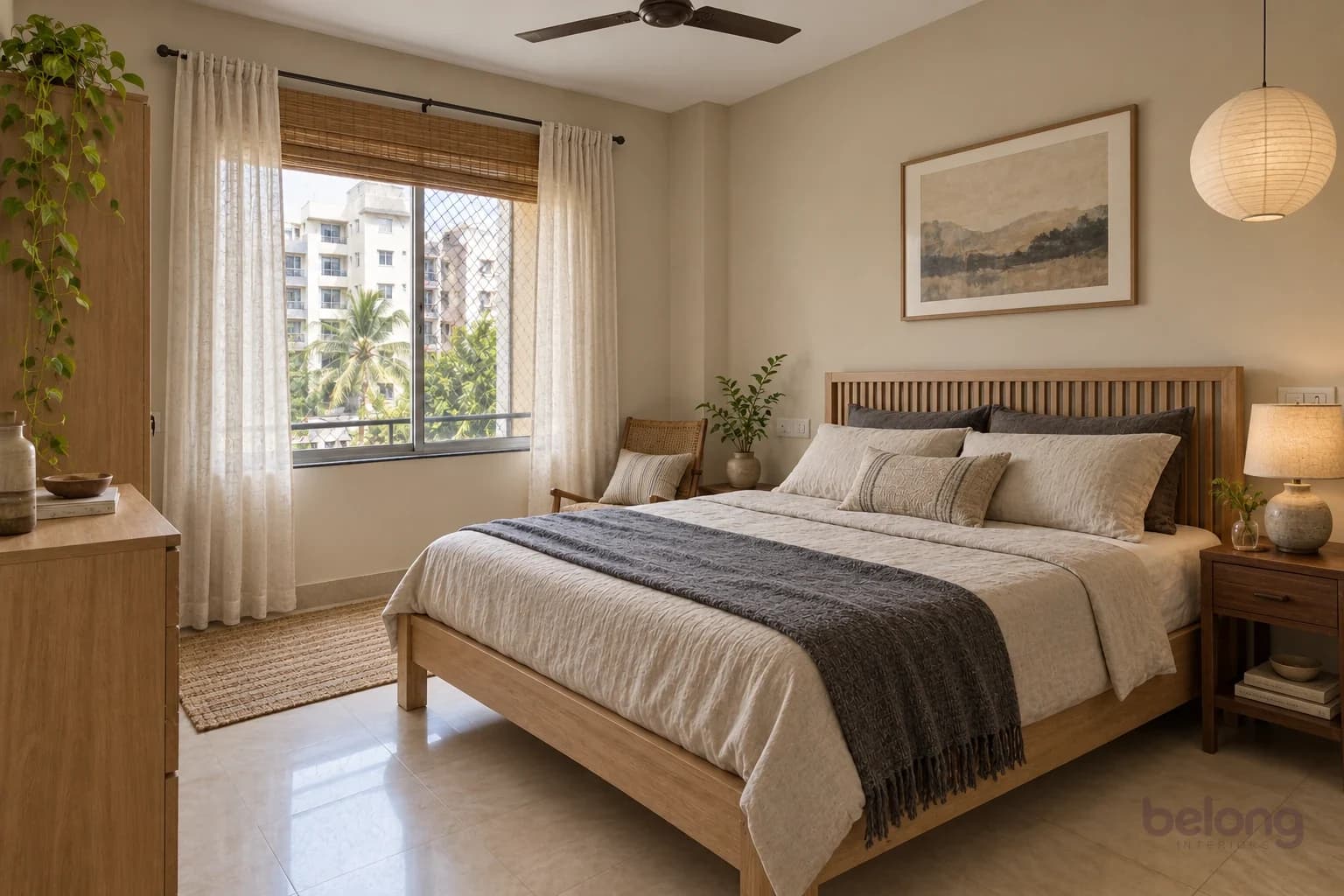
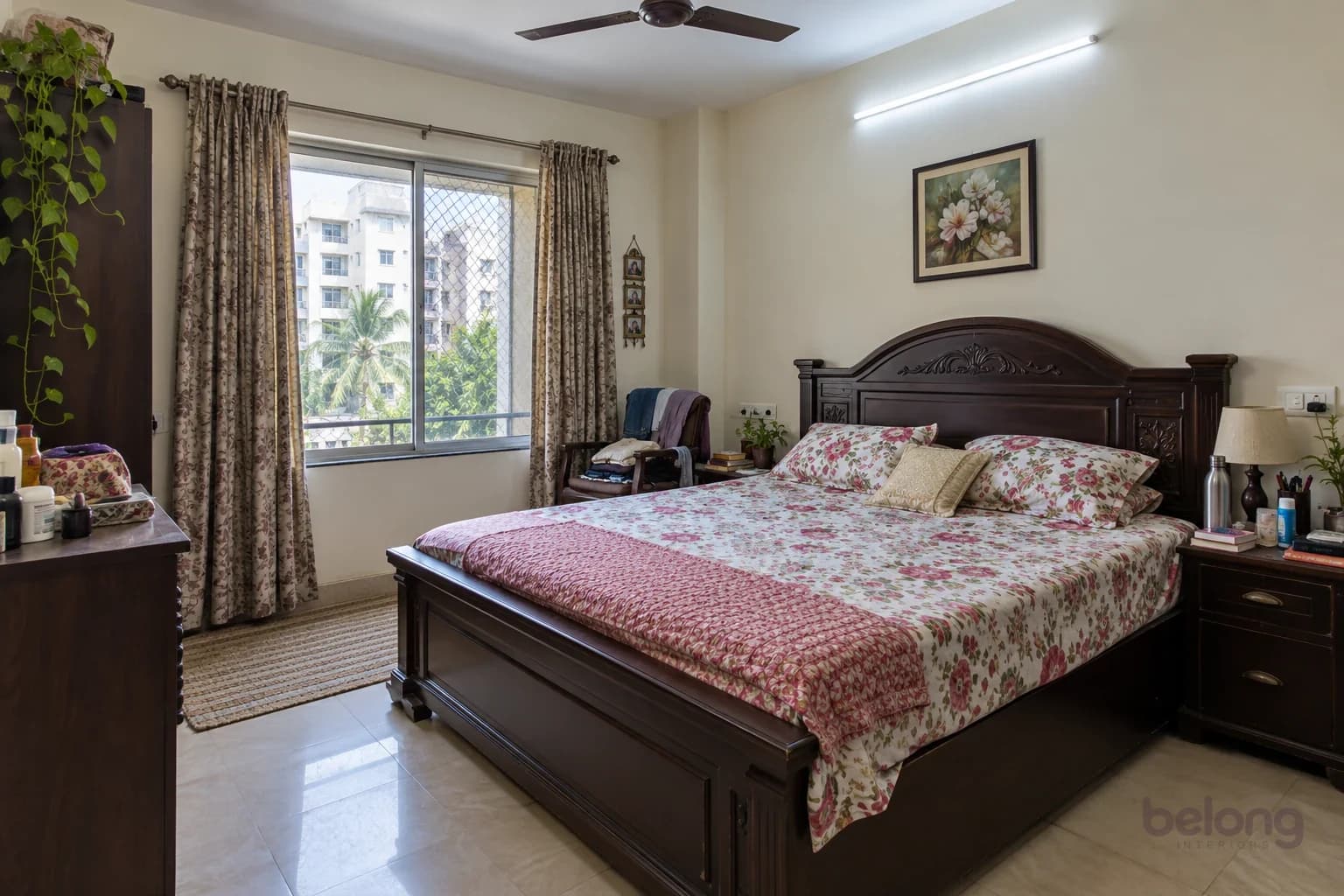
Photos are AI-generated design studies, not completed Belong projects.
Common Japandi mistakes, and what to do instead
Beige on beige is the most common slip. Without a dark anchor and some texture, a Japandi room can feel flat and sleepy. Add walnut, charcoal or ink black in small doses, and mix rough and smooth surfaces. The opposite mistake is emptying a room so completely that it feels cold. Japandi keeps a few loved, useful things in view; it just gives them space.
Avoid theme-park décor. Buddha heads used as ornaments, faux bamboo, desktop sand gardens and fake cherry blossom say “Zen” in the loudest possible voice and miss the point entirely. Imitation materials, such as plastic rattan and printed wood, undo the honesty the style depends on. Choose fewer, real things instead.
Finally, mind the practical details. Clutter hidden behind doors that don’t close is still clutter. Too many paper lanterns turn calm into a lantern shop. Cool white bulbs make warm woods look grey. And indoor bonsai rarely thrive, because in Japan most bonsai traditionally live outdoors. Test your eye with the quick game below.
Scandi, Japandi or both?
Eight things you might find in a room. Tap the style you think each one belongs to.
A pale birch chair on slim legs, with a sheepskin on the seat
Tap the side you think it belongs to.
Questions, answered
What is Japandi interior design?
Japandi is a blend of Japanese and Scandinavian design. It combines Japanese restraint, craft and empty space with Scandinavian comfort and warmth: low furniture, light and dark woods, earthy colours, natural textiles and a few handmade objects.
What colours are used in Japandi?
Warm neutrals such as off-white, oat, sand and greige make the base. Clay, moss green, grey-green and walnut brown add depth, ink black adds thin lines of contrast, and small accents of persimmon, clay red or indigo bring warmth.
What is the difference between Japandi and Scandinavian?
Japandi furniture sits lower, its woods mix pale with dark, its colours are earthier and it shows fewer objects, arranged asymmetrically. Scandinavian rooms are brighter, use paler woods throughout and add more cosy textiles and candles.
Is Japandi still in style?
Yes. Japandi is less a passing trend than a modern name for a long-standing exchange between Japanese and Nordic design. Its natural materials, comfort and calm are timeless, and it adapts easily as tastes shift warmer and more personal.
How can I make my home Japandi on a budget?
Declutter first, then add warm bulbs, a paper lantern, linen or cotton cushions in earthy colours, a jute rug and one dark wood piece. Group your favourite handmade objects in threes and leave space around them. Cane and bamboo are affordable and authentic.
Does Japandi work in small apartments?
Very well. Low furniture keeps sightlines open, closed full-height storage hides clutter, sliding screens save door space and the pared-back palette makes rooms feel larger. Choose fewer, multi-purpose pieces.
Is Japandi suitable for Indian homes?
Yes. Shoes-off entrances, floor seating, cane, handloom cotton, terracotta and indigo already feel familiar. Keep beds and main seats at a comfortable height, avoid real paper in humid rooms and choose termite-resistant timber or treated veneers.
What is the difference between Japandi and wabi-sabi?
Wabi-sabi is a Japanese idea about the beauty of imperfection and age; as a decorating style it is rustic and raw. Japandi borrows that appreciation for the handmade, but it is more refined and comfortable, with clean lines and Scandinavian practicality.
Every home is different. These notes are a starting point for your own brief, with the details shaped around your space and the people who use it.
Thinking of someone who’d like this?
Send it to the people you’re planning with, or keep it on your reading list.