Bedroom interior design: a room that helps you rest.
We spend about a third of our lives asleep, and much of the rest of a bedroom’s life is spent getting dressed, reading, folding laundry and talking at the end of the day. A good bedroom does all of that gracefully, and above all it helps you sleep. Here is how to design one: what sleep science asks of the room, how much space a bed really needs, storage, light, colour and comfort in a warm, humid climate.
Design for sleep first
Sleep researchers keep coming back to four things: dark, cool, quiet and calm. Light is the big one. In one well-known study, ordinary room light in the hours before bed delayed the release of melatonin, the hormone that tells the body it is night, in almost everyone tested and shortened its night-time window by about 90 minutes. Another found that sleeping one night with a moderate light on raised heart rate and affected blood sugar the next morning. Blackout curtains and warm, dim lamps in the evening are not luxuries.
Temperature comes next. Sleep studies suggest a cool room, around 18 to 20 °C, but most Indian bedrooms rely on fans and air conditioning in a warm, humid climate. Humid heat makes sleep lighter, because sweat can’t evaporate and the body can’t cool down. A practical target is an AC set around 24 to 26 °C with a ceiling fan moving the air; Indian air conditioners now default to 24 °C, and each degree higher saves energy.
Air and screens matter too. With the door and windows shut, a bedroom with two sleepers can build up a lot of carbon dioxide overnight; in one study, opening a window cut night-time levels from about 2,600 parts per million to about 660, and people fell asleep faster. Trickle ventilation, a mesh-screened window or a door undercut helps. And light from phones and tablets in bed delays sleepiness, so give devices a home across the room.
A restful bedroom, in six pictures
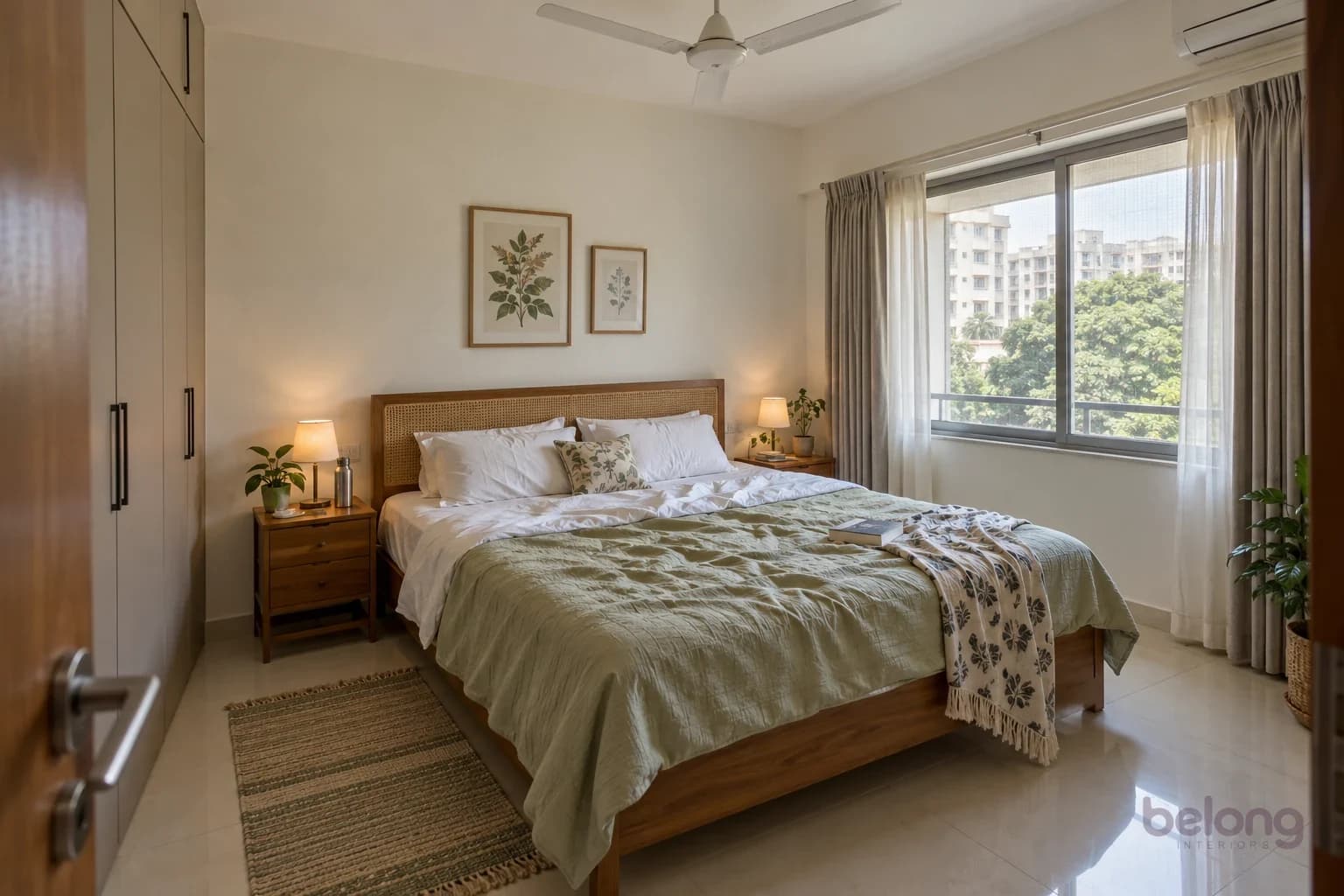
Soft light, breathable linen, a cane headboard and a chair for reading. Tap any photo to see it big.
Photos are AI-generated design studies, not completed Belong projects.
Where the bed goes, and the space around it
Put the headboard against a solid wall, ideally where you can see the door from the bed. Avoid placing the bed right under a window, where light, draughts and rain can reach it, and keep it out of the direct blast of the AC. If the room allows, the bed should be the first thing you see when you walk in, not the wardrobe.
Then give it room to breathe. Leave at least 24 inches, about 60 cm, to walk along each side of the bed; 30 to 36 inches feels comfortable. Allow about three feet at the foot if there is furniture or a wardrobe opposite. Hinged wardrobe doors need around 36 inches clear in front of them to open fully, while sliding doors need much less, which is why they are so popular in compact rooms.
Bedside tables work best when their tops sit within a couple of inches of the mattress, so a glass of water is easy to reach. Fix reading lights to the wall or headboard so the beam falls over your shoulder, and put a two-way switch by the bed for the main light, so nobody has to get up in the dark. Try sizing a bed for your room in the planner below.
Will it fit?
Choose a room, a bed and a wardrobe to see the plan, the walking space around the bed and what else fits.
Queen in 10×12 ft: 28 in each side ✓, a little tight for hinged shutters
- Left side28 in
- Shutters28 / 36 in
- Foot of bed36 in
Every inch is working hard in this one.
A guide drawn to scale from common sizes. Measure your own room, doors and windows before you buy.
Blackout curtains and warm, dim lamps in the evening are not luxuries.
Bed and room sizes, in plain numbers
Indian mattress sizes vary by an inch or two between brands, but the common ones are easy to remember. A single is 36 inches wide, a double 48, a queen 60 and a king 72, each usually 72, 75 or 78 inches long. Bed frames add a few centimetres on each side, and a headboard adds a few more at the top.
Typical flat bedrooms range from about 10×10 to 12×14 feet. A 10×10 room is happiest with a double or a queen and little else; add a wardrobe along one wall and a double leaves more walking space. A 10×12 room fits a queen and a wardrobe comfortably. An 11×13 room can take a king, and a 12×14 room fits a king, a wardrobe and a reading chair or desk.
Storage beds help in smaller rooms. A hydraulic bed lifts up to reveal one big space, perfect for luggage and winter quilts, but check the rated load and warranty of the lift mechanism. Drawer beds are cheaper and better for sorted, smaller things, as long as there is room for the drawers to pull out.
Bedroom numbers worth knowing
The measurements that make a bedroom comfortable. Switch between millimetres and inches.
600–900mm
Walkway beside the bed
At least 600 mm (24 in); 750–900 mm feels comfortable.
900mm
In front of hinged wardrobes
So the doors open fully and you can stand at them.
450mm
In front of sliding wardrobes
Much less, which is why they suit small rooms.
560–600mm
Wardrobe depth
Deep enough for hangers to hang freely.
1,680–1,830mm
Long hanging
Dresses, kurtas and coats.
1,000mm
Short hanging
Shirts and tops. Stack two rails for double the space.
450–500mm
Bed height for elders
Feet flat and knees at about a right angle when sitting.
75–150lux
General bedroom light
Soft overall light; brighter only where you read.
2,200–3,000K
Warm white bulbs
Golden, evening-friendly light. Lower numbers are warmer.
24–26°C
AC with a ceiling fan
A comfortable, energy-wise setting for a humid night.
Typical ranges from Indian design practice, the National Building Code and energy guidance. Your room may differ.
Wardrobes and storage that keep the room calm
A bedroom feels restful when everything has a place behind a door. Wardrobes are usually about 22 to 24 inches deep, so hangers fit without catching. Plan the inside around what you own: long hanging space of about 66 to 72 inches for dresses and kurtas, short hanging of about 40 inches for shirts, which can be stacked two high, shelves about 12 to 15 inches apart and a few shallow drawers for accessories.
Sarees deserve their own plan. Shallow pull-out trays let you see each fold without lifting a stack. Wrap silks in soft cotton or muslin rather than plastic, which traps moisture, refold them every few months on new lines, and keep naphthalene away from zari. A few sachets of silica gel on each shelf help through the rainy months.
Above the wardrobe, a loft takes suitcases and off-season bedding. Under the bed takes quilts. A bench at the foot of the bed can be a trunk. Keep a small charging spot in the bedside drawer, a tray for watches and keys, and a place for tomorrow’s clothes, and the room will stay calm with very little effort.
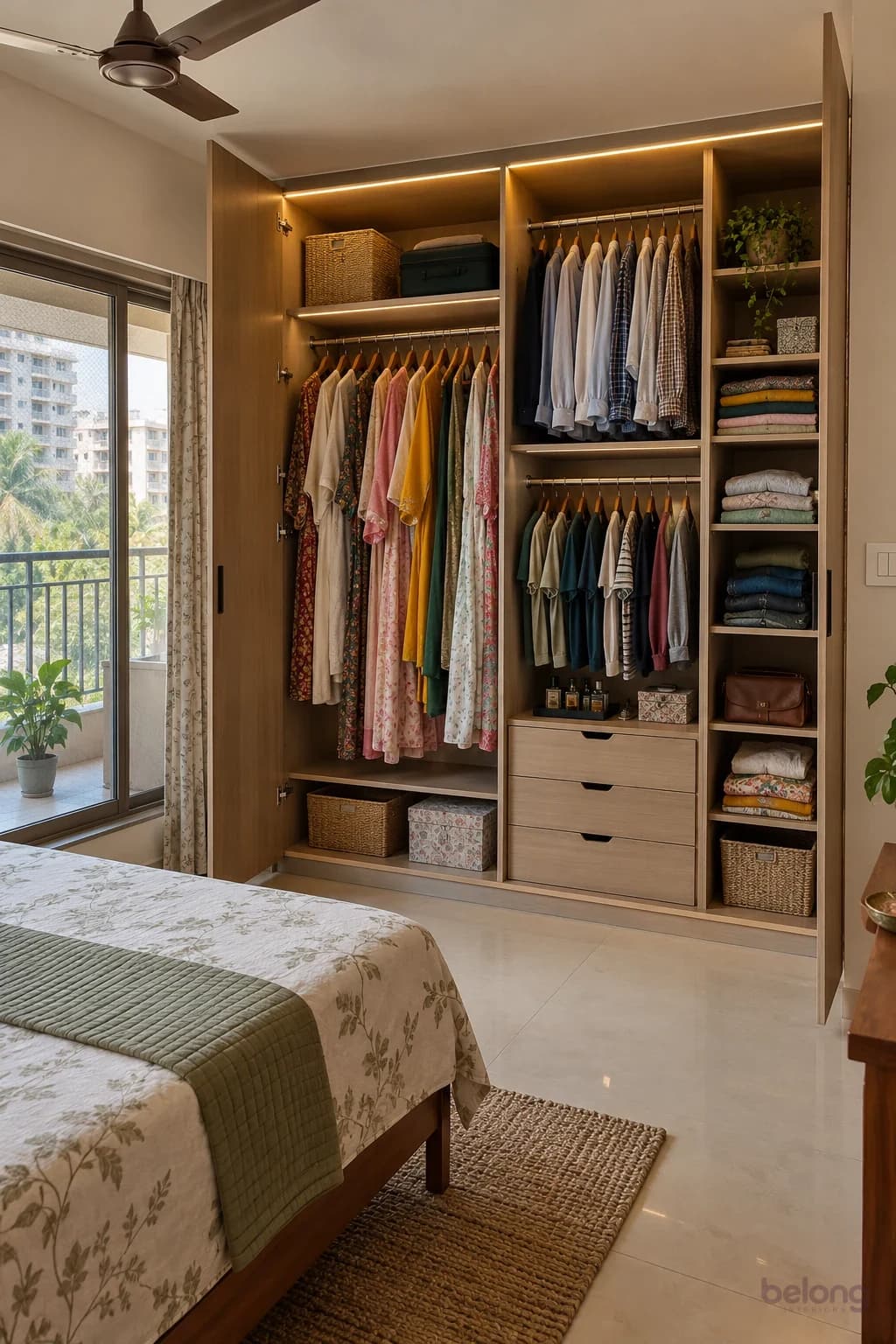
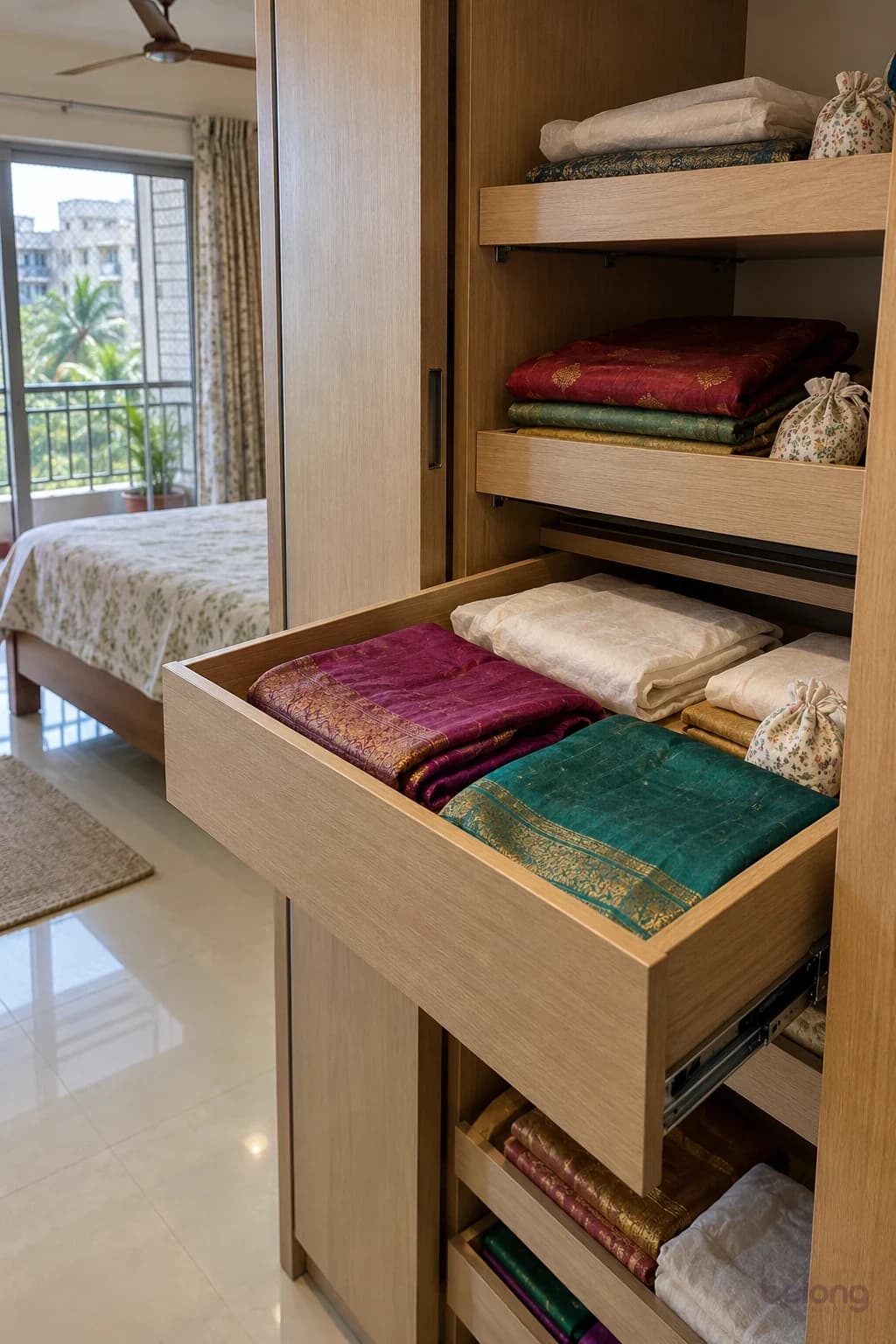
Light it like a sunset
A bedroom needs at least three kinds of light. A soft, even ambient light, ideally on a dimmer, for getting ready. Task light for reading in bed, dressing and finding things in the wardrobe; small sensor strips inside the wardrobe are a joy. And gentle accent light, perhaps a wash behind the headboard, for the evening. India’s building code suggests fairly low general light in bedrooms, around 75 to 150 lux, with brighter light only where you read.
Choose warm white bulbs, around 2,200 to 3,000 kelvin, and avoid bright, cool-white tube lights as the only option. Harvard researchers note that even dim light can affect melatonin, and blue-rich light does so most strongly, so warmer and dimmer is better as bedtime approaches. A dim, warm night light placed low near the floor helps anyone who gets up in the night, especially grandparents.
Then let the morning in. Bright daylight soon after waking helps set the body clock for the next night. A sheer curtain plus a blackout layer on a double track gives you both: darkness at night and soft light by day. Try winding a bedroom down for the night below.
Get the room sleep-ready
Move the clock towards bedtime and switch on the changes that help: darkness, warm light, cool air, no phone and a tidy room.
Still in daytime mode
0/5It’s 9 pm and the room still feels like daytime. Try a change below.
A friendly illustration of sleep advice from sleep researchers and health services, not medical advice.
Colours for calm
You may have read that people with blue bedrooms sleep longest. That idea comes from a hotel chain’s survey, which found people in blue rooms reported almost eight hours a night. It is fun, but it is not science, and researchers who review colour psychology say the evidence is still thin and depends a lot on context.
What does help is softness. Low-saturation, mid-to-light colours reflect gentle light and feel restful. Warm neutrals such as linen and mushroom, soft greens such as sage, dusky blues and clay pinks are all easy to sleep beside. Matte finishes reduce glare from lamps. A deep colour can be cosy too, a midnight navy or a chocolate brown, if the room gets good daylight and you balance it with light bedding.
Keep the brightest colours for things you can change: cushions, a throw, a print. Try the palettes on the bedroom below.
Six restful bedroom palettes
Each in 60-30-10 order: walls, bed and textiles, then accents. Tap a chip to try it on the walls, or copy its code.
Soft linen walls, sage bedding and warm walnut.
- 60% · WallsLinen
- 30% · Bed & textilesSage
- 10% · AccentsWalnut
Every colour, one tap away. Tap a chip to try it on the walls.
Codes are close screen matches, not brand paints. Test real samples in your own evening light.
Textiles, headboards and the bed itself
In a warm climate, bedding matters more than almost anything. Cotton percale is crisp and breathable and is often recommended for people who sleep hot. Linen is cooler still and softens with every wash. Sateen feels silky but can trap more heat. Don’t chase thread counts: some numbers are inflated by counting twisted strands separately, and the quality of the fibre matters more. Many “bamboo” sheets are really rayon made from bamboo, which can be lovely, but read the label.
Headboards set the mood. Upholstered ones are soft to lean on and help with acoustics; choose removable covers in humid weather. Cane and rattan breathe beautifully. Wood panelling and fluted panels add warmth and can hide wiring for reading lights. A fabric-panelled wall behind the bed softens sound too.
Underfoot, tiles and stone stay cool, which is welcome most of the year; a cotton or wool rug beside the bed adds warmth and quiet. Curtains should be lined for darkness, hung high and wide, and full enough to fold softly. Tap the dots on the photo to see each choice at work.
Seven choices that help you rest
From curtains to the ceiling fan, every choice in this room has a job. Tap a number to see it.
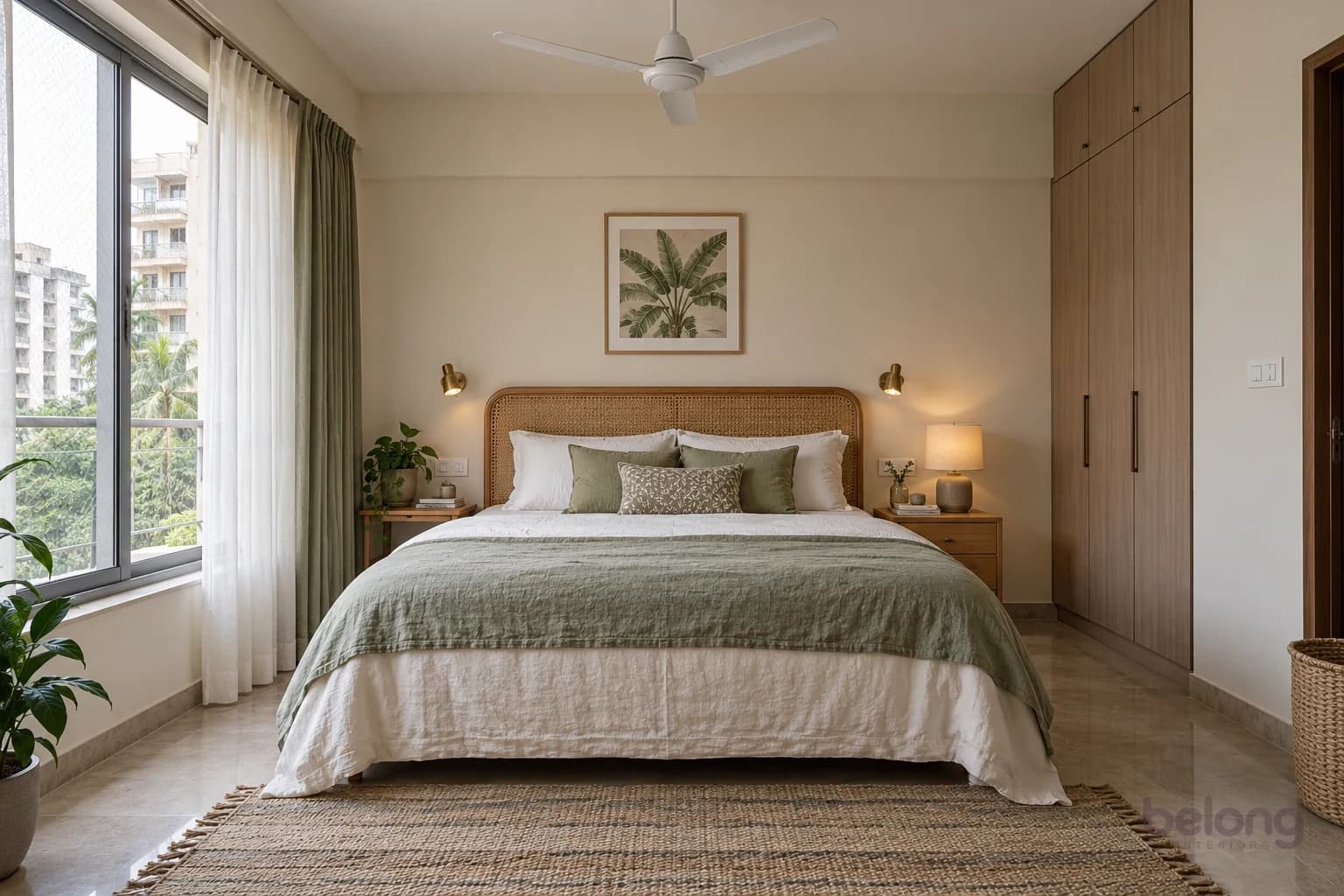
1Sheer plus blackout. Two curtains on a double track: soft daylight by day, real darkness at night.
Photos are AI-generated design studies, not completed Belong projects.
Cool, fresh and dry in a warm, humid climate
Let air move. Windows on two walls allow cross-ventilation, and mosquito mesh lets you keep them open at night. A ceiling fan over the centre of the bed, with no light fitting directly under its blades, keeps the air moving and lets you set the AC a couple of degrees warmer. Place the AC’s indoor unit so the air sweeps across the room rather than straight at the pillows, and use its dry mode in the monsoon.
Humidity is the quiet enemy of a bedroom. Mould grows when humidity stays high, and the advice from environmental agencies is to keep indoor humidity below about 60 percent. Wardrobes on outside walls suffer most, so use water-resistant plywood, leave a small air gap at the back, consider ventilated shutters and keep silica gel or a wardrobe dehumidifier inside. Open the doors and air the clothes on dry days.
Choose light-coloured curtains and breathable fabrics, and keep heavy synthetic throws for the cooler months. Drag the line below to see how a few of these changes transform an ordinary bedroom.
Same bedroom, made restful
Before and after: warm lamps instead of a tube light, blackout curtains, the bed out of the AC’s blast and breathable bedding.
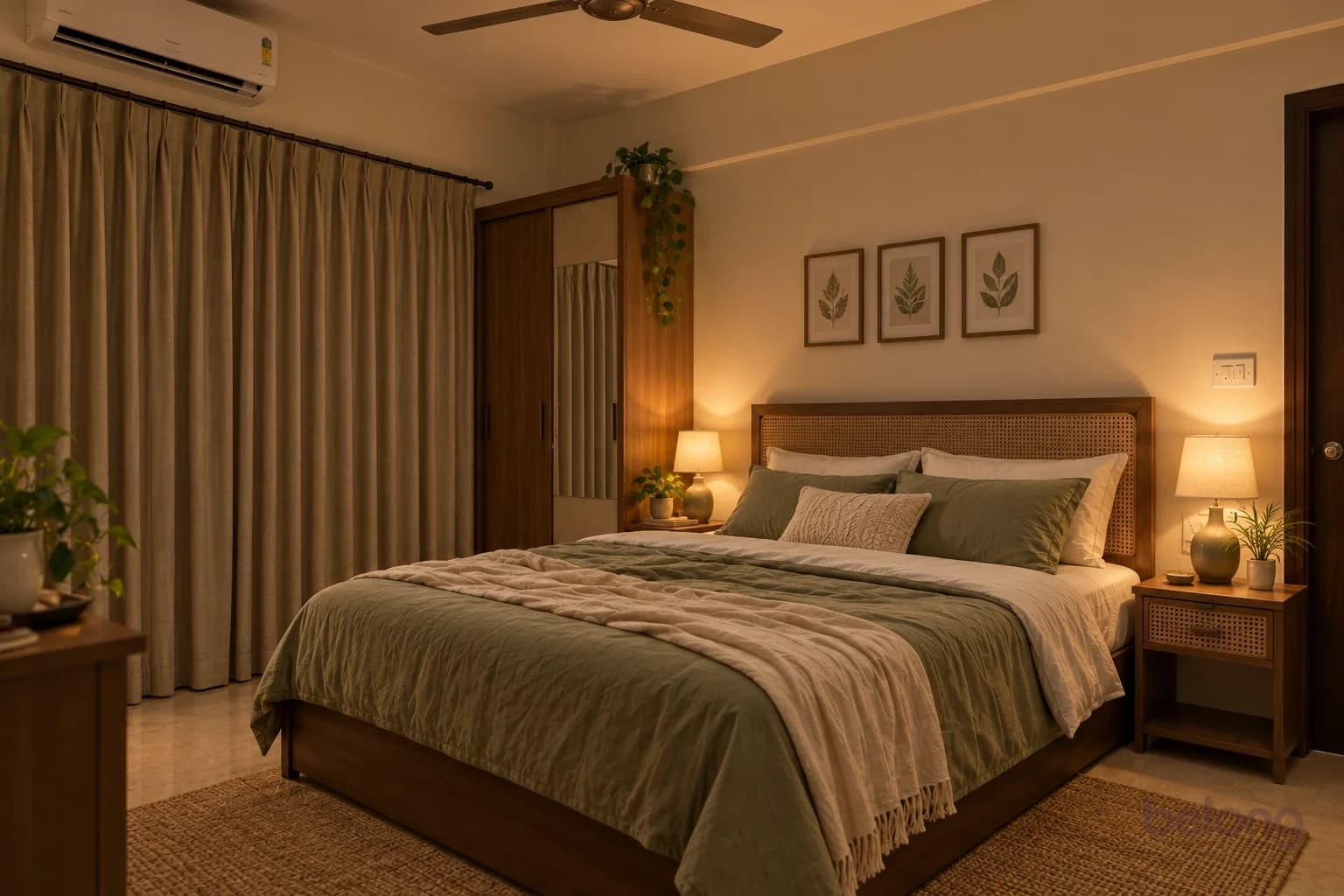
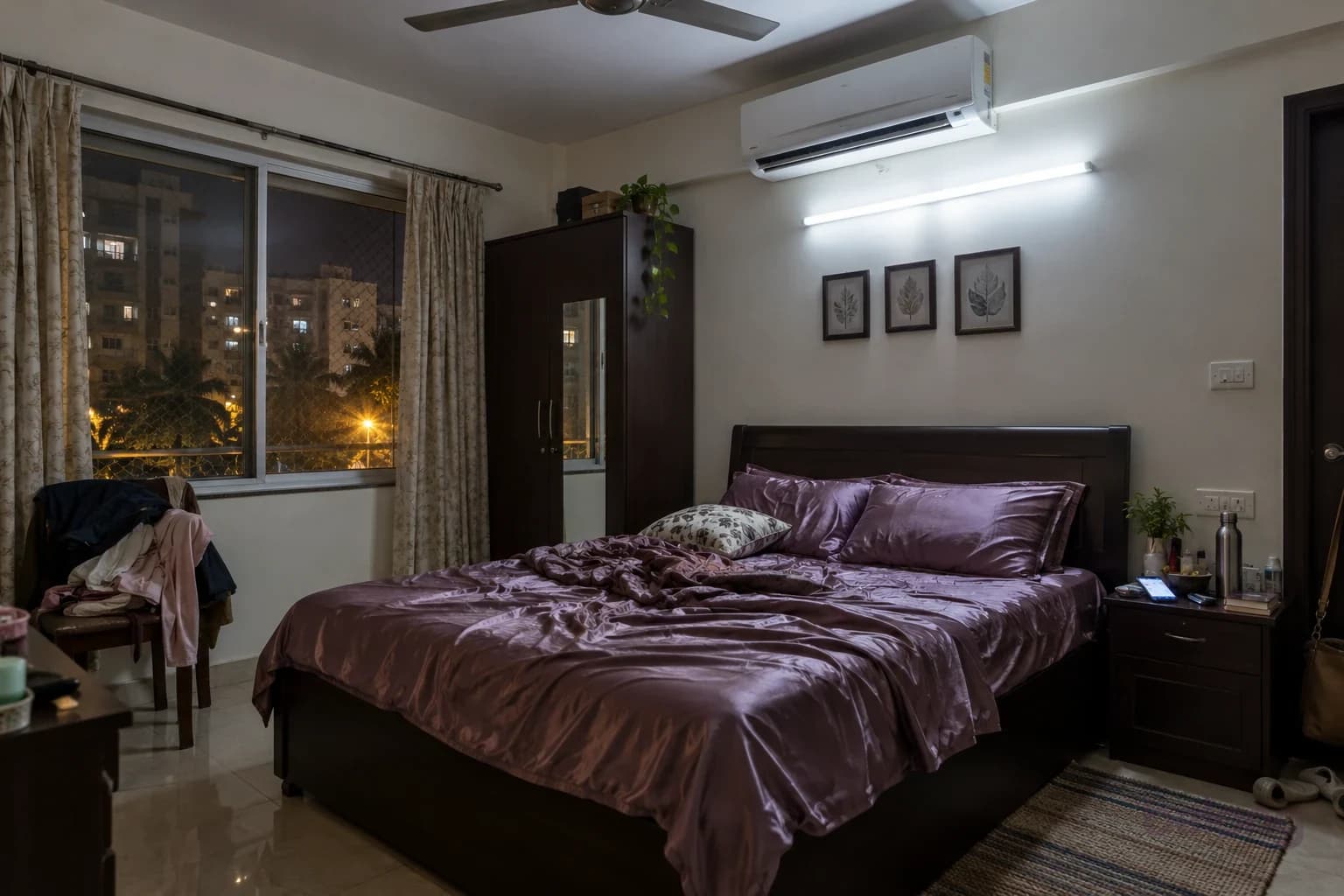
Photos are AI-generated design studies, not completed Belong projects.
Bedrooms for everyone in the family
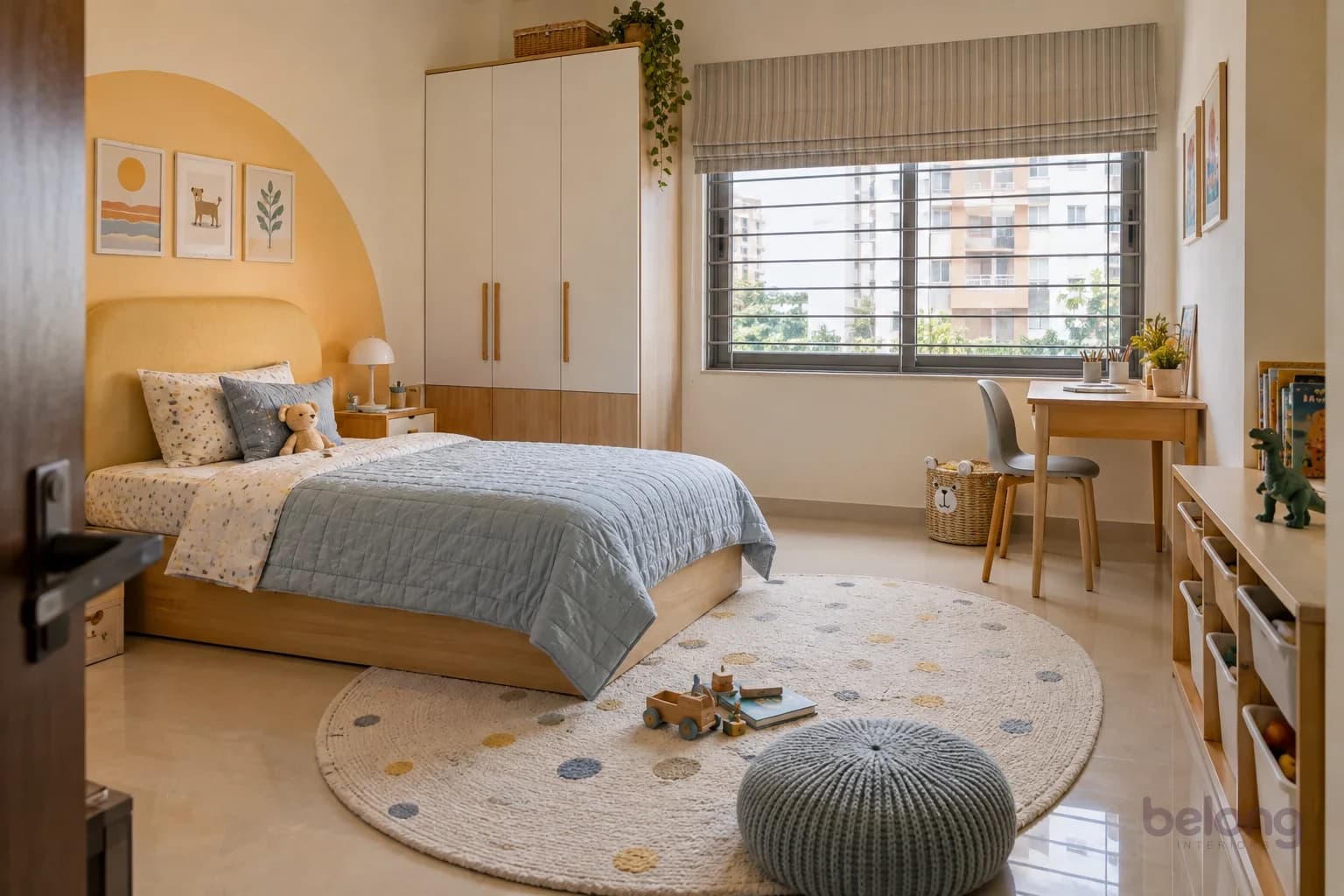
A main bedroom can hold a little more: a dressing area near the wardrobe, a reading chair, perhaps a bench. If two people sleep differently, give each side its own reading light and switch, consider two duvets instead of one, and keep any desk out of the sleeper’s line of light. A children’s room should grow with the child: a bed they can keep for years, adjustable wardrobe rails, a pinboard and a proper study desk.
If you choose bunk beds, safety comes first. The top bunk needs guardrails on both sides, and most safety advice keeps young children off the top bunk altogether. For grandparents, raise the bed so they can sit with feet flat and knees at about a right angle, usually around 45 to 50 cm, and add a sturdy bedside table to lean on, a non-slip floor, switches they can reach from the bed and soft path lights to the bathroom.
Guest rooms need less than you think: a good bed, a lamp and a charger, hooks or a luggage rack instead of a full wardrobe. A small bedroom feels bigger with a hydraulic bed, wall-hung bedside shelves, a full-height wardrobe painted the same colour as the walls and curtains hung at ceiling height. Tour the rooms below.
A bedroom for everyone in the family
Pick a room, or swipe the photo, for the ideas that make it work.
01 / 08
Main
Room for a little more: dressing, reading, a bench.
- A bench at the foot of the bed for dressing.
- A dressing area beside the wardrobe, not the bed.
- A reading chair by the window with its own lamp.
Palette
Main: Room for a little more: dressing, reading, a bench.
Photos are AI-generated design studies, not completed Belong projects.
Six ways to style a bedroom
Japandi: a low oak bed at a comfortable height, oat and charcoal linen, a paper lamp and one ceramic. Scandinavian: pale walls, light wood, a cosy throw, plants and simple bedside lamps. Warm modern Indian: a teak or sheesham bed, a cane headboard, handloom cotton, a block-printed quilt and a brass lamp.
Minimal: a handle-free wardrobe in the wall colour, a built-in bed, hidden cove lighting and a single artwork. Mid-century: a tapered-leg bed in walnut, a globe lamp and mustard or teal accents. Classic: an upholstered headboard, mouldings on the wall and matching lamps on both sides. Whichever you choose, the sleep rules stay the same. Swipe through the styles below.
Six ways to dress a bedroom
Drag or swipe along the row, and tap a photo to see it big.
Japandi
Low oak, oat and charcoal linen, a paper lamp, one ceramic.
Scandinavian
Pale walls, light wood, a cosy throw and plants.
Warm modern Indian
Teak and cane, block-printed cotton and a brass lamp.
Minimal
A wardrobe in the wall colour, hidden light, one artwork.
Mid-century
Walnut on tapered legs, a globe lamp, mustard and teal.
Classic
An upholstered headboard, mouldings and matching lamps.
Photos are AI-generated design studies, not completed Belong projects.
What about Vastu?
Many families ask about Vastu when planning a bedroom. Traditional guidance often suggests sleeping with your head towards the south or east, placing the main bedroom in the south-west of the home, avoiding a mirror that faces the bed and keeping the bed out of direct line with the door. These are traditional beliefs rather than scientific findings, and families follow them to different degrees.
Happily, several of them sit well with good design. A bed that isn’t in line with the door feels more private. A mirror that doesn’t catch street light keeps the room darker. A calm, uncluttered room is restful whatever direction it faces. Our practical guide to Vastu for flats goes into more detail.
Did you know?
A few curious facts about beds and sleep. Tap for the next one.
did you know?
The oldest known beds are layers of grass laid on ash in a cave in South Africa, at least 200,000 years old. They even included an insect-repelling plant.
Source: Science, 2020
Common bedroom mistakes, and easy fixes
The most common is the biggest bed in the smallest room: a king in a 10×10 room leaves too little space to walk, so choose a queen or a double and enjoy the floor. Another is a hinged wardrobe opposite the bed with no room for the doors to open. A single bright tube light, no dimmer and no two-way switch make evenings harsher than they need to be.
Comfort mistakes are easy to fix. An AC blowing straight at the bed, a bed under the window, a sealed room with no fresh air, thin curtains that let street light in, bedside tables far higher or lower than the mattress, or a reading light that shines into a partner’s eyes. Each one has a simple answer.
Then there is the slow one: wardrobes on damp outside walls, built from ordinary board, with no ventilation. They smell of damp by the second monsoon. Use water-resistant board, a small air gap and silica gel from day one, and plan a place for suitcases so they don’t end up on top of the wardrobe. Run through the check below to see how restful your room is.
How restful is your bedroom?
Tick what your room already has. Whatever’s left is an easy upgrade.
0/10restful touches
Let’s make it restful
Tick what your bedroom already has, and see what to add next.
Questions, answered
What is the standard size of a bedroom in India?
Flat bedrooms are typically about 10×10 to 12×14 feet. A 10×10 room suits a double or queen bed, 10×12 fits a queen with a wardrobe, and 12×14 fits a king, a wardrobe and a chair or desk.
Is a 10×10 room big enough for a king-size bed?
Not comfortably. A king is 72 inches wide, so in a 10×10 room it leaves very little space to walk. A queen leaves about 24 inches on each side when nothing else lines the walls; with a wardrobe along one side, a double is the comfortable choice.
How much space should I leave around a bed?
At least 24 inches, about 60 cm, on each side you walk past, with 30 to 36 inches feeling comfortable. Allow around 36 inches at the foot if furniture or a wardrobe faces the bed, and about 36 inches clear in front of hinged wardrobe doors.
What are the standard bed sizes in India?
Common mattress widths are single 36 inches, double 48, queen 60 and king 72, usually 72, 75 or 78 inches long. Sizes vary slightly between brands, and frames and headboards add a little extra.
Sliding or hinged wardrobe: which is better for a small bedroom?
Sliding doors need no swing space, which makes them ideal in compact rooms, though only part of the wardrobe opens at a time. Hinged doors show everything at once and cost less, but need about 36 inches clear in front of them.
Which lights are best for a bedroom?
Layer warm white light, around 2,200 to 3,000 kelvin: a dimmable ambient light, wall-mounted reading lights, wardrobe lighting and a low, dim night light for getting up. Avoid relying on a single bright cool-white tube light.
What temperature should a bedroom be for sleep in a hot climate?
Sleep research favours a cool room, but in a warm, humid climate a practical target is an AC set at about 24 to 26 °C with a ceiling fan moving the air. Lower humidity and air movement make a big difference to comfort.
How do I stop fungus in my wardrobe during the monsoon?
Use water-resistant plywood, leave a small air gap at the back on outside walls, consider ventilated shutters, keep silica gel or a wardrobe dehumidifier inside, store silks in cotton rather than plastic and air the wardrobe on dry days.
Every home is different. These notes are a starting point for your own brief, with the details shaped around your space and the people who use it.
Thinking of someone who’d like this?
Send it to the people you’re planning with, or keep it on your reading list.